TL;DR

Get the little things that make your day delivered free with Prime
- Fast, free delivery on millions of items
- Prime Video, Amazon Music and more included
- Member-only deals all year
A History of Sorts remembrance titled “They Gave Their Today for Our Tomorrow” honors people who died in war and urges readers to remember their sacrifice. It identifies a photograph as showing an injured U.S. soldier receiving the last Sacrament from Chaplain Anthony Dolavira in France, and also features photographs of the Netherlands American War Cemetery in Margraten. The post does not provide dates for the images or further details about the soldier.
History of Sorts has published a remembrance titled “They Gave Their Today for Our Tomorrow,” pairing a photograph described as showing an injured U.S. soldier receiving the last Sacrament in France with images of the Netherlands American War Cemetery in Margraten. The post honors those who died for people they would never meet, while leaving the identities and circumstances of the soldier and the photographs’ dates unspecified.
The post describes the wartime image as showing Chaplain Anthony Dolavira of Brooklyn giving the last Sacrament to an injured U.S. soldier “somewhere behind the lines in France.” It does not give a date, identify the soldier, or state the precise location where the photograph was taken. The account therefore frames the image as a scene of wartime ministry and injury, without supplying further biographical or operational details.
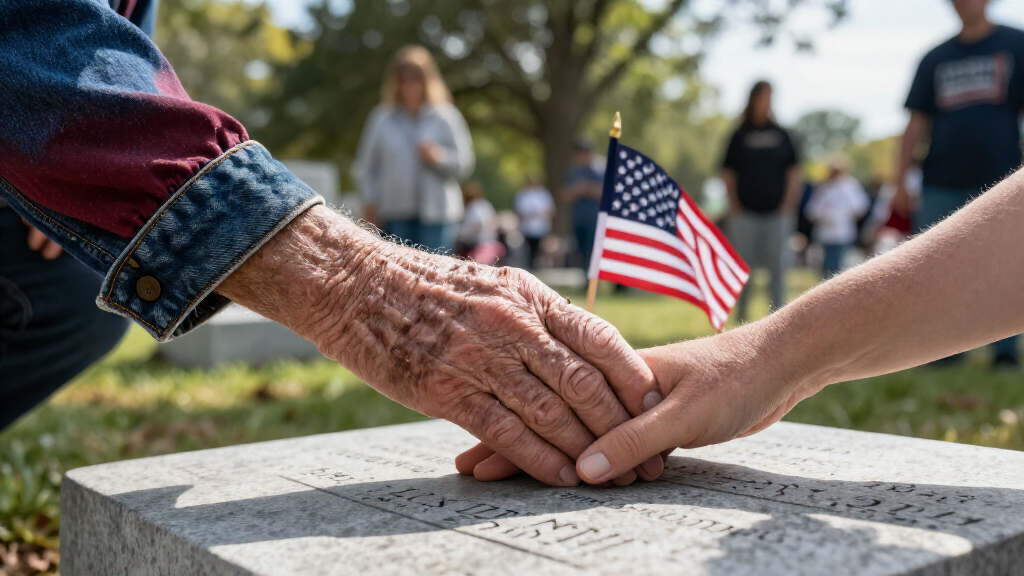
Other photographs in the post show the Netherlands American War Cemetery in Margraten. The writing connects the cemetery images to its central message: people who gave their lives in wartime made sacrifices for a future they would not experience. It asks readers to cherish that future and remember those who died. The supplied material does not specify when the cemetery photographs were taken or identify individual graves.
The post is a memorial reflection rather than a newly reported discovery or a detailed historical investigation. It includes an appeal for voluntary donations of $2 or more to support the site’s continuing work, while saying that contributions are optional. No fundraising total or stated deadline is provided.
They Gave Their Today For Our Tomorrow
A memorial reflection links a wartime image of an injured U.S. soldier in France with photographs of the Netherlands American War Cemetery in Margraten. Its message is gratitude, remembrance, and care for the future shaped by sacrifice.
A Photograph and a Dutch Cemetery
The post pairs a scene of wartime ministry with a place of remembrance. Together, the images make the human cost of war and the later act of honoring the dead tangible.
A moment of ministry
The image is described as Chaplain Anthony Dolavira of Brooklyn giving the last Sacrament to an injured U.S. soldier “somewhere behind the lines in France.” The soldier is not named.
Date and precise location unspecifiedA place of remembrance
Other photographs show the Netherlands American War Cemetery. The post does not date these images or identify individual graves shown.
Photograph dates and graves unspecifiedFrom sacrifice to gratitude
The reflection is a personal act of remembrance, not a report of new research, a newly identified person, or a formal event.
War’s personal toll
The injured serviceman evokes vulnerability behind the broad story of wartime service.
Lives represented
The cemetery images connect the reflection to people who died and the graves that honor them.
A future to cherish
Readers are asked to value the future and remember those who sacrificed their lives for people they would never meet.
Details behind the images
The supplied account gives a limited description. These boundaries matter when interpreting the photographs as historical evidence.
Image identification remains limited
The soldier’s identity, injuries, outcome, and the photograph’s date and exact location are not provided. No source record or caption history is cited. The cemetery images are not dated, and no individual graves are identified.
Wartime image
An injured U.S. soldier in France
Place of memory
The cemetery at Margraten
Words of gratitude
A reflection on sacrifice
Ongoing remembrance
Cherish the future; remember the dead
“To those who gave their today for my tomorrow, I bow humbly and respectfully and hope I was worth your sacrifice.”
History of Sorts · RemembranceKey questions
What does the title refer to?
It is the refrain of a memorial reflection honoring people who died in war and expressing gratitude for their sacrifice.
Who is shown in the France photograph?
The post describes an injured U.S. soldier receiving the last Sacrament from Chaplain Anthony Dolavira of Brooklyn. It does not name the soldier.
Where and when was the image taken?
The post says “somewhere behind the lines in France,” with no precise location or date.
Does the post announce a new finding or event?
No. It presents a remembrance and a voluntary donation appeal. Contributions of $2 or more are welcome but optional; no target or deadline is given.
Remembering the Dead at Margraten
The post brings together an image of an injured serviceman and photographs of a military cemetery to make remembrance tangible: its subject is both the immediate cost of war and the later act of honoring those who died. The Margraten cemetery photographs give the reflection a specific place, while the image attributed to the scene in France evokes the personal vulnerability behind wartime service.
For readers, the post’s significance lies in its memorial purpose, not in a newly announced policy or historical finding. It asks audiences to consider the lives represented by wartime photographs and cemetery graves, and to treat remembrance as an ongoing responsibility. The wording is an expression of the site’s perspective; the post does not present testimony from the soldier, the chaplain, or relatives of those buried at Margraten.
The distinction matters when interpreting the material. The images and their descriptions are presented as historical, but the available account offers limited documentation about their provenance. The emotional message can be understood on its own, while specific claims about the people pictured or the circumstances of the scene would require further records not included in the post.
Popular right now

Dyson V8 Cordless Vacuum

Bose QuietComfort True Wireless Earbuds with Active Noise Cancellation, Black

LG C2 Series 65-Inch OLED evo 4K Smart TV (OLED65C2PUA, 2022)
As an affiliate, we earn on qualifying purchases.
A Photograph and a Dutch Cemetery
The remembrance is published under the name History of Sorts – WORLD WAR II, MUSIC, HISTORY, HOLOCAUST. Its text repeats the phrase “They gave their today for our tomorrow” as a refrain, moving from the idea of sacrifice to a direct expression of gratitude. The writer says those who died sacrificed their lives for people they would never meet and asks whether the writer has been worthy of that sacrifice.
The account identifies the French scene only as taking place “somewhere behind the lines.” It names Chaplain Anthony Dolavira and says he was from Brooklyn, but provides no service record, unit, date, or further account of his role. Similarly, the cemetery is identified as the Netherlands American War Cemetery in Margraten, but the supplied text does not explain which graves or memorial features appear in the photographs.
These limits shape what can be reported from the post: it is a personal act of remembrance accompanied by historical imagery, not a full account of the soldier’s story or the cemetery’s history. The material contains no new archival findings, interviews, or claims of a formal commemoration taking place.
“They gave their today for our tomorrow.”
— History of Sorts – WORLD WAR II, MUSIC, HISTORY, HOLOCAUST
Details Behind the Images
The post does not identify the injured U.S. soldier or give a date or exact location for the photograph attributed to Chaplain Dolavira. It also does not provide a source record or caption history establishing when the image was taken. No information is given about the soldier’s injuries, what happened afterward, or whether he survived.
The cemetery images are identified as being from Margraten, but the post does not date them or name the people represented in the visible graves. It is also unclear whether the images were taken by the site’s author or reproduced from another collection. The supplied material does not indicate any response from a museum, archive, or military historian, and it announces no related event or new research.
Further Historical Identification
The post does not announce a follow-up publication, public ceremony, or archival project. Further identification of the soldier or the photograph would depend on additional documentation, such as an original caption, an archive catalogue entry, or service records. Until such material is available, the details should remain limited to the description provided: an injured U.S. soldier, Chaplain Anthony Dolavira, and a location somewhere behind the lines in France.
Readers seeking to support the site can use its stated voluntary donation option; the post says contributions of $2 or more are welcome but not required. It provides no fundraising target, closing date, or account of how much has been raised. For now, the development is the publication of a remembrance, with the underlying image identifications and any future historical follow-up still unresolved.
Key Questions
What does “They Gave Their Today for Our Tomorrow” refer to?
It is the title and repeated phrase of a memorial reflection honoring people who died in war and expressing gratitude for their sacrifice.
Who is shown in the photograph from France?
The post describes an injured U.S. soldier receiving the last Sacrament from Chaplain Anthony Dolavira of Brooklyn. It does not name the soldier.
Where was the soldier’s photograph taken?
The post says it was taken somewhere behind the lines in France. It gives no precise location or date.
What is shown in the other photographs?
They are identified as photographs of the Netherlands American War Cemetery in Margraten. The post does not date them or identify individual graves.
Does the post announce a new event or historical finding?
No. The supplied material presents a remembrance and donation appeal, not an announcement of a ceremony, new research, or newly identified people.
Source: History of Sorts – WORLD WAR II, MUSIC, HISTORY, HOLOCAUST