

This guide shows you how to make a motivational quote notebook from start to finish: choosing a notebook, curating quotes that actually mean something to you, laying out pages by hand, and building a system for adding new quotes over time. The finished product is a physical notebook you can open any morning for a two-minute boost, give as a personalized gift, or use as a companion journal alongside goal-setting.

Get the little things that make your day delivered free — and shop member deals
- Fast, free delivery on millions of items
- Access to Prime Big Deal Days deals on October 6–7
- Prime Video, Amazon Music and more included
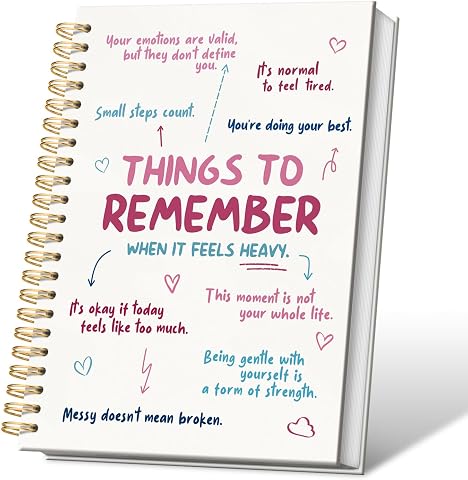
VONTP Inspirational Motivational Spiral Notebook
- ✔ Brand: VONTP
- ✔ Size: 5.5 x 8.3 inches
- ✔ Sheet Count: 80 sheets
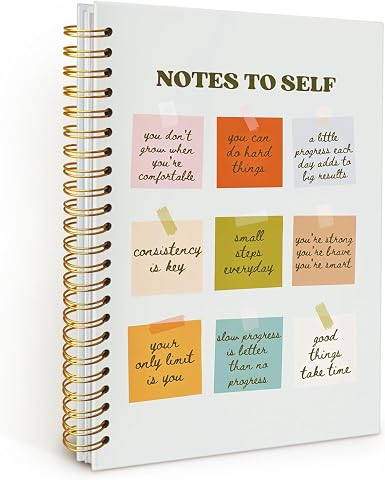
Wheatwin Note to Self Mental Health Journal
- ✔ Brand: Wheatwin
- ✔ Dimensions: 5.5 x 8.3 inches
- ✔ Pages: 80 lined pages
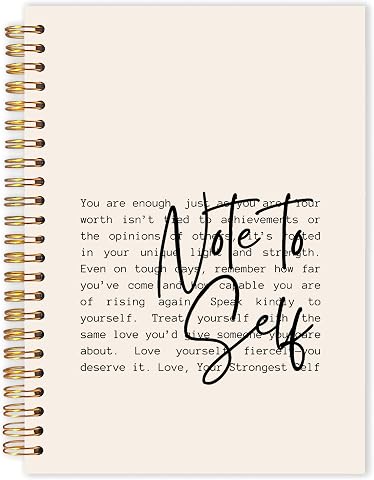
Qabliqo Inspirational Spiral Notebook
- ✔ Brand: Qabliqo
- ✔ Size: 5.5 x 8.3 inches
- ✔ Binding: Spiral with hardcover
This is a beginner-level craft and writing project. No artistic talent is required — neat handwriting and basic supplies are enough. Expect the first notebook to take 2-3 hours spread over a day or two, mostly spent selecting and copying quotes rather than assembling anything.
This guide is for anyone who wants a tangible, personalized collection of motivational quotes instead of scattered screenshots and bookmarked pages. If you want to make one as a gift, see the FAQ section for adaptation tips.
Difficulty: Beginner | Time: 2-3 hours (plus drying time for glue or ink)
What You’ll Need
Tools & Materials:
- A blank notebook (80-120 pages, lined or dotted, A5 size works well)
- Two pens: one black or dark blue for writing, one accent color (optional)
- Pencil and eraser for light layout guidelines
- Ruler
- Sticky notes or sticky tabs (optional, for section markers)
- Washi tape or decorative stickers (optional)
- A source list of quotes: books, saved screenshots, quote websites, song lyrics
Knowledge:
- Basic handwriting or print lettering
- Ability to copy text accurately from a source
Choose a notebook you like the feel of. A notebook that is too fancy will make you hesitant to write in it; one that is too flimsy will fall apart from daily handling. A softcover A5 dotted notebook is a good middle ground. If you plan to add stickers or glue in printed quotes, thicker paper (100 gsm or higher) resists wrinkling and ink bleed.
Before writing anything in ink, gather at least 20-30 candidate quotes. Running out of material halfway through is the most common reason these notebooks get abandoned.
VONTP Inspirational Motivational Spiral Notebook
The VONTP Inspirational Motivational Spiral Notebook takes our top spot because it solves the problem that matters most for a notebook you’ll write in daily: paper quality. Its 80 sheets of smooth ruled paper resist ink bleed-through, which means you can confidently use gel pens or heavier ink without ruining the page behind your notes. Neither the Wheatwin nor the Qabliqo makes an equivalent claim, and that difference is why this model leads the lineup.Structurally, it matches the category standard: a sturdy hardcover that protects notes in a backpack, a spiral binding that lays completely flat, and the familiar 5.5 x 8.3 inch size that slips into most bags. The 0.32-inch line spacing is generous, which suits larger handwriting and makes the notebook feel less cramped for study or meeting notes. Its bold, colorful quote designs are more assertive than the Qabliqo’s minimalist cover — motivating for some, visually louder than others will want.The tradeoffs are real, though. Reported translation errors in product descriptions hint at quality-control inconsistencies, and as a newer product its long-term durability is less proven than more established options. Compared with the Wheatwin, it also lacks gift packaging — fine for personal use, less ideal if you’re wrapping a present.
Pros:
- Smooth, high-quality paper that resists ink bleed-through
- Durable hardcover protects notes from everyday wear and tear
- Spiral binding lets the notebook lay completely flat for comfortable writing
- Compact size and generous line spacing suit both quick notes and longer journaling sessions
Cons:
- Translation errors in listings suggest possible quality-control issues
- Bold, colorful designs may feel too loud for professional settings
- Arrives without individual gift wrapping
Best for: Everyday writers, students, and teachers who want dependable paper quality alongside their daily dose of motivation
Not ideal for: Gift-givers who need polished, presentation-ready packaging, or buyers who prefer subtle, understated cover designs
Bottom line: The most complete package in this lineup — the VONTP wins on paper quality and build, provided its bold aesthetic fits your taste.
“The most complete package in this lineup — the VONTP wins on paper quality and build, provided its bold aesthetic fits your taste.”
Wheatwin Note to Self Mental Health Journal
Where the VONTP leads on paper and the Qabliqo leads on neutrality, the Wheatwin Note to Self Mental Health Journal leads on emotional intent. Its feminine bow pattern paired with positive affirmations is the most explicit mental-health-focused design in this lineup, and that framing shapes everything about who it’s for: it works best as a guided-feeling personal journal or a supportive gift rather than a work notebook.Build-wise it holds its own against our top pick. The hardcover is sturdy, and the double coil binding is a genuine step up from standard single-wire spirals — it distributes stress better and tends to survive being tossed into a school bag longer. It arrives individually wrapped, which the VONTP does not, making it the stronger choice straight out of the shipping box for birthdays or end-of-term teacher gifts.The limitations mirror the category’s. Eighty lined pages is the same ceiling as the VONTP’s 80 sheets, so heavy journalers will burn through it quickly. And unlike the Qabliqo’s clean, broadly appealing cover, the bow design is decisive — it will delight the right recipient and miss completely with the wrong one. If you are unsure about the recipient’s taste, choose the Qabliqo instead.
Pros:
- Positive affirmations woven into a distinctive, intentional mental-health-focused design
- Double coil binding is more durable than standard single-wire spirals
- Individually wrapped, so it arrives gift-ready
- Versatile enough for journaling, doodling, and creative projects
Cons:
- Only 80 lined pages, limiting for daily heavy journaling
- Feminine bow pattern narrows its appeal considerably
- Paper quality is not specified to the same standard as the VONTP’s
Best for: Buyers seeking a supportive, affirmation-driven journal for themselves or as a heartfelt gift for someone who loves feminine stationery
Not ideal for: Heavy journalers who need more than 80 pages, or anyone put off by overtly feminine design elements
Bottom line: The most emotionally targeted option here — the Wheatwin is the right pick when the design’s affirmation-first personality is exactly the point.
“The most emotionally targeted option here — the Wheatwin is the right pick when the design’s affirmation-first personality is exactly the point.”
Qabliqo Inspirational Spiral Notebook
The Qabliqo Inspirational Spiral Notebook earns its place as the safest gift in this comparison. Its clean, modern cover with a single inspirational quote sits stylistically between the VONTP’s bold, colorful layouts and the Wheatwin’s distinctly feminine bows — which is precisely why it works when you don’t know the recipient’s taste well. It reads as thoughtful without imposing a personality.Functionally, it covers the essentials well: a hardcover paired with a spiral binding that opens flat, smooth pages, and a lightweight build that genuinely fits in a handbag. Its versatility claim runs slightly wider than the other two — the listing emphasizes planning and sketching alongside journaling — and the blank-margin-friendly layout makes those uses plausible rather than just marketing copy. Compared with the Wheatwin, it lacks individual wrapping; compared with the VONTP, it doesn’t emphasize bleed-resistant paper. It is, in other words, the well-rounded middle: excellent at nothing, weak at nothing.The main risk is aesthetic mismatch — a quote-forward cover is inherently polarizing, and one person’s daily motivation is another’s desk clutter. If you’re buying for an office setting or someone who prefers minimal stationery, this is the one to choose of the three, but verify the specific cover quote matches the recipient before ordering.
Pros:
- Clean, modern design with the broadest appeal in the lineup
- Hardcover plus lay-flat spiral binding for comfortable writing anywhere
- Lightweight and genuinely handbag-portable
- Handles note-taking, journaling, planning, and light sketching equally well
Cons:
- Quote-forward cover may not suit all settings or personal preferences
- Does not specify bleed-resistant paper like the VONTP
- No individual gift wrapping included
Best for: Gift-givers who want a safe, broadly appealing motivational notebook for birthdays, holidays, or workplace exchanges
Not ideal for: Buyers prioritizing maximum page count or specific paper performance claims over design versatility
Bottom line: The most universally giftable option of the three — pick the Qabliqo when broad appeal matters more than specialized paper or a specific design personality.
“The most universally giftable option of the three — pick the Qabliqo when broad appeal matters more than specialized paper or a specific design personality.”
As an Amazon Associate we earn from qualifying purchases.
Before You Start
Decide the purpose of your notebook before opening it, because purpose determines layout. Three common formats work well: (1) a daily-open flip book with one quote per page, meant to be read each morning; (2) a themed collection organized by topic — perseverance, courage, gratitude, rest — with a table of contents; (3) a quote-and-response journal where you write a short reflection under each quote. Pick one format now. Mixing formats halfway through is the single biggest cause of a notebook that feels cluttered and gets abandoned.
Also decide your attribution rule: every quote gets its author’s name written underneath, and quotes you don’t know the source of get labeled ‘Unknown’ rather than guessed. Misattributed quotes are extremely common online, so verify authors for any quote you found on social media.
Warning: do a pen test on the last page of the notebook before starting. Some pens bleed through thin paper, which ruins double-sided pages.
Step-by-Step Instructions
Step 1: Test your pens on the last page
Open the notebook to the final page and write a sample line with each pen you plan to use. Press normally, then check the other side of the page for bleed-through or heavy ghosting. Set aside any pen that shows through. If all your pens bleed, the notebook paper is too thin — switch to gel pens with fine tips (0.38-0.5 mm) or a pencil-based layout.
Tip: Write the date and the word ‘pen test’ next to your samples so future you knows why the last page has marks on it.
Check: You have at least one pen that writes cleanly with no visible bleed-through on the reverse side.
Step 2: Curate 20-30 quotes before writing anything
On a separate sheet of paper or a notes app, collect 20-30 candidate quotes from your sources. Copy each quote in full, with the author’s name. Apply a quick filter to each one: keep only quotes that make you feel something on the first read. If a quote sounds impressive but does not apply to your life or goals, cut it. A notebook of 25 quotes that genuinely move you beats a notebook of 100 generic ones.
Tip: Include at least five quotes about persistence or starting small. These are the ones you will need most on difficult days, and they age better than quotes about winning.
Check: You have a written list of 20-30 complete quotes with authors, and you can say honestly why at least half of them matter to you.
Step 3: Choose your layout and set up the first page
Decide between one quote per page or two quotes per page. One per page suits larger handwriting and quote-plus-reflection formats; two per page fills a notebook faster and suits a daily flip book. On page one, write a short title in pencil first — for example, ‘Quotes for the hard days’ plus your name and the date. This title page marks the notebook as yours and sets the tone. Once you are happy with the pencil layout, go over it in pen.
Tip: Leave the first spread (two facing pages) for the title and, if you are organizing by theme, a simple table of contents. Adding a contents page later is frustrating.
Check: Page one has a title, your name, and the date, written in pen with no smudges.
Step 4: Create a pencil guide for the first quote
Turn to the first quote page. Using your ruler, draw one faint pencil line across the page about a third of the way down — this is where the quote will end and the author line begins. If a quote is longer than three lines of your handwriting, count the words and estimate how many lines it needs, then start high enough on the page to center it. Faint pencil guides keep spacing consistent without visible structure.
Tip: Write the quote in pencil first if your handwriting is uneven. Pencil can be erased; ink cannot.
Check: You have light pencil marks that are visible up close but would not show in a photo of the page.
Copy the quote in pen, letter by letter, checking every few words against your source list. Transcription errors are permanent in ink, so slow down on short words like ‘not’ and ‘never’ — a dropped ‘not’ reverses a quote’s meaning. Under the quote, write the author’s name in smaller handwriting, preceded by an em dash. Example: ‘— Maya Angelou’. Erase any visible pencil lines once the ink is fully dry.
Tip: Wait 30-60 seconds before closing the page or erasing pencil. Ink that feels dry to a fingertip touch can still smear under an eraser.
Check: The quote matches your source word for word, the author is named, and the pencil guide is erased.
Step 6: Add an optional accent or reflection line
Below the author line, use your accent pen to underline one phrase in the quote that hits hardest, or write one sentence about why you chose it: the situation you were in, the goal it supports, or the fear it answers. This takes 30 seconds per page and is what turns a copied list into a personal artifact.
Tip: If you plan to keep adding to this notebook for a year, date each entry. Reading your own one-line notes from months earlier is often more motivating than the quotes themselves.
Check: Each completed page has three elements: quote, author, and either an underline or a one-sentence personal note.
Step 7: Repeat in short sessions, not one marathon
Complete pages in sessions of 5-8 quotes, then stop. Handwriting quality drops noticeably after 45 minutes, and a rushed final section will look inconsistent with a careful first section. Spread the work across two or three sittings. Keep alternating: pencil guide, quote, author, note, erase, next page.
Tip: Mark your place with a sticky note so a half-finished notebook does not get shelved and forgotten.
Check: After each session, completed pages look visually consistent — same margins, same author-line placement.
Step 8: Add section tabs or a blank ‘future quotes’ section
If you organized by theme, place sticky tabs on the first page of each section and label them. If you used a single running format, reserve the last 10 pages for ‘future quotes’ and write that heading there. This gives you a designated home for quotes you encounter later, which keeps the notebook alive instead of finished-and-forgotten.
Tip: Store a small pen clipped inside the back cover or in the notebook’s elastic band so you can capture a quote the moment you hear one.
Check: The notebook has visible navigation — tabs or a labeled future-quotes section — and a pen travels with it.
Step 9: Put the notebook into daily use
Choose a fixed trigger: open it with morning coffee, after your alarm, or before starting work. Read one page — not the whole book. The value comes from small, repeated contact, not binge reading. If you chose the quote-and-reflection format, write one sentence per day under that day’s quote.
Tip: Keep the notebook somewhere you physically see it daily: nightstand, desk, or kitchen counter. Out of sight means out of use within two weeks.
Check: One week in, you have opened the notebook at least five times without forcing yourself.
Common Mistakes to Avoid
- Writing quotes in ink without verifying the author — Check attribution before copying, especially for quotes found on social media, where misattribution is routine. If two sources disagree or you cannot verify, write ‘attributed to’ before the name, or ‘Unknown’.
- Starting with a nearly empty quote list and stalling at page five — Complete the full 20-30 quote curation step before touching the notebook. The notebook is the last stage, not the first.
- Using a notebook too precious to write in — Pick a functional notebook, not an heirloom. Hesitant, tiny handwriting in an expensive notebook looks worse than confident writing in a plain one.
- Filling every page edge to edge with no margins or blank space — Leave at least one blank line between the quote, author, and note. Crowded pages are harder to read and impossible to add to later.
Troubleshooting
Problem: Ink bleeds through the page
Solution: Stop using that pen immediately and re-test alternatives on the last page. Fine-tip gel pens or ballpoints bleed least. If the notebook paper is simply too thin, dedicate facing spreads to single pages and skip the reverse side, or start a new notebook and keep this one for pencil-only entries.
Problem: A transcription error is already written in ink
Solution: For small errors, neatly cross out with a single line and rewrite the word above — visible corrections fit the handmade character. For a quote ruined beyond reading, write the corrected version on the next page and add a small ‘x’ in the corner of the failed page to skip it.
Problem: Handwriting deteriorates partway through and pages look inconsistent
Solution: Take a break and finish the remaining pages in a later session. If the inconsistency bothers you, frame later pages differently — add a border line around the quote — so the variation looks intentional rather than rushed.
Problem: You stop using the notebook after a few weeks
Solution: Relocate it to a visible daily spot and shrink the habit: one page, one breath, done. If the quotes themselves feel stale, that is a curation problem — retire the notebook’s used pages by folding a ribbon at your place, and add five fresh quotes that speak to your current situation.
What Success Looks Like
Your notebook is complete when all of the following are true: every filled page contains a quote, a verified author, and either an underline or a personal note; handwriting is legible and pages are visually consistent; there is a title page with your name and date; the last pages are reserved for future quotes with a pen stored with the notebook; and you have opened it at least five times in the first week. Hold the notebook at arm’s length and flip through — consistent margins and clean pages are the visual proof it worked.
Next Steps
Once the notebook is in daily use, three follow-ups keep it valuable. First, review it monthly: reread your one-line notes and underline any quote that has lost its punch — those are candidates for replacement. Second, refill the future-quotes section whenever you hear a line worth keeping; a good rhythm is adding one quote per week. Third, if the notebook fills completely, date the final page and start volume two — comparing the themes you collected a year apart is a surprisingly clear record of what you were working toward. If you made this as a gift, add a handwritten note on the title page explaining why you chose the first quote for that person before giving it.
Frequently Asked Questions
What size notebook is best for a motivational quote notebook?
A5 (roughly 5.8 x 8.3 inches) with 80-120 pages suits most people. It is large enough for comfortable handwriting and small enough to carry or keep on a nightstand. Pocket-size notebooks work for a one-quote-per-page flip book but cramp quote-and-reflection formats.
How many quotes should I start with?
Curate 20-30 before writing. That fills 15-20 pages comfortably with reflections, leaves room to grow, and prevents the most common failure mode: running out of quotes mid-notebook and abandoning the project.
Can I make this as a gift, and what should I change?
Yes, and it makes a strong personalized gift. Change two things: choose quotes matched to that person’s goals or shared experiences rather than your own, and write a short note on the title page explaining your first chosen quote. Fill 15-25 pages and leave the rest blank so they can continue it.
What if my handwriting is bad?
Slow, deliberate writing in pencil first, then pen, improves appearance more than talent does. Alternatives that sidestep handwriting entirely: print quotes in a clean font, trim them to page size, and glue them in, adding only handwritten author lines and notes. Glue sticks wrinkle paper less than liquid glue.
Should I organize quotes by theme or chronologically?
Organize by theme if you want to find the right quote for a specific mood — that requires a table of contents and tabs. Use chronological order if the notebook is more of a daily companion where you read the next page regardless of mood. Theme organization takes 20 extra minutes of setup and pays off if you have more than 30 quotes.
Fall Picks
fall essentials
As an affiliate, we earn on qualifying purchases.