
TL;DR

Get the little things that make your day delivered free with Prime
- Fast, free delivery on millions of items
- Prime Video, Amazon Music and more included
- Member-only deals all year
A LifeHack report says a short breathing practice may reduce physical arousal temporarily, but it does not change the conditions a person returns to or establish a lasting change in baseline. The report distinguishes a one-time two-minute exercise from a four-week study that tested five minutes of daily cyclic sighing.
LifeHack’s report says a two-minute breathing practice can lower physical arousal temporarily, but it cannot by itself change a person’s baseline or remove the conditions driving stress. The distinction matters because a return of stress after a short period of calm does not, by itself, show that the exercise failed.
The report describes a nervous system reset as a brief practice, often slow breathing, intended to reduce physical arousal in the moment. It says the effect may last for a limited period, while a person returns to their usual level of arousal when the practice ends. It cautions that advice promoting resets may leave readers with no clear way to judge how long a result should last.
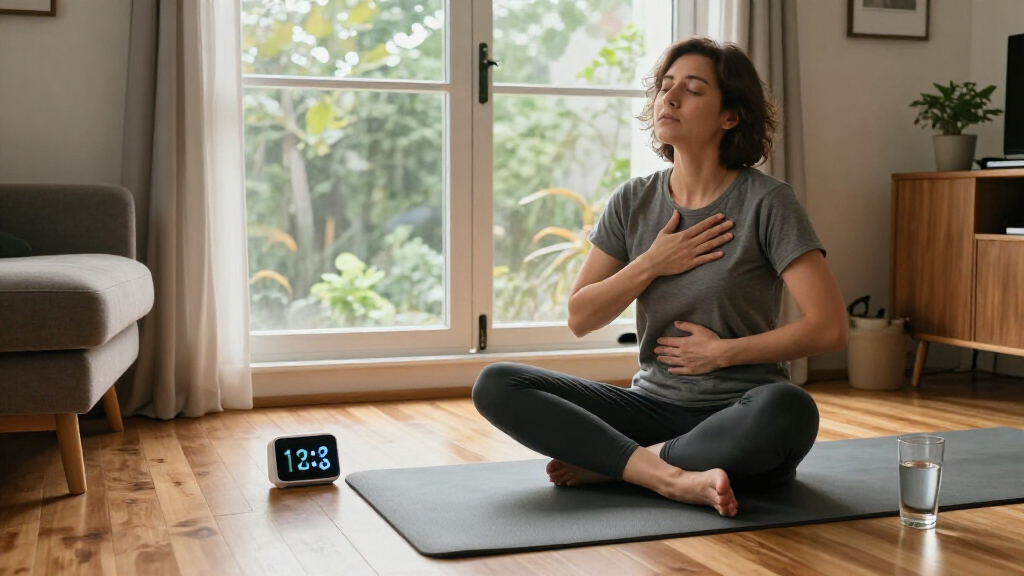
One study cited by LifeHack compared four five-minute daily practices in 108 participants over 28 days. The report says cyclic sighing performed better than mindfulness meditation on mood improvement and lowering respiratory rate. The tested breathing pattern involved a nasal inhale, a second shorter inhale, and a long, slow exhale through the mouth. The study tested five minutes each day for four weeks; it did not test whether a single two-minute session produces the same result.
LifeHack also cites a review of 15 studies of breathing at fewer than 10 breaths per minute, which found autonomic changes during the practice, including increased heart rate variability. The report cautions that a change in HRV is not itself a measurement of stress. A wearable reading reflects a bodily measure, not a standalone stress score.
Why Brief Calm Has Limits
The distinction between a temporary shift and a lasting change helps readers set realistic expectations. If tension returns during the same workday, that pattern may reflect ongoing demands or a person’s usual baseline; the report says it should not automatically be treated as proof that a breathing practice was ineffective.
That framing also changes what readers might track. Rather than cycling through new techniques, LifeHack suggests noticing when the same feeling returns and how often it does across a working week. The report presents sleep, the shape of the day, and the size of a workload as possible inputs to examine. These are suggestions in the article, not findings from the cited breathing trial.
The broader point is practical: a short exercise may help someone manage a moment, while persistent strain may call for attention to the circumstances around that moment. The report argues that a technique designed for immediate relief cannot be expected to carry someone through hours of unchanged stress.
Popular right now

Hisense 85 U7 Mini-LED ULED 4K UHD Smart Google TV (85U7SG, 2026)

Dyson W1 PencilWash Cordless Wet and Dry Floor Cleaner with Dock

De'Longhi Dinamica Plus Fully Automatic Espresso Machine
As an affiliate, we earn on qualifying purchases.
What the Breathing Studies Tested
LifeHack separates research on breathing from the broader claims sometimes attached to the word “reset.” The report cites laboratory research by Giles and colleagues from 2014, published in PLOS ONE, saying cortisol typically peaks 10 to 30 minutes after a stressor has ended and takes around 90 minutes to move back toward baseline. It stresses that this is a laboratory time course, not a universal countdown for every person or stressful event.
On that account, someone who starts breathing shortly after a stressful meeting may be practicing while the body’s stress response is still developing. The report characterizes the exercise as a possible way to experience the period with lower heart rate, not as a means of canceling the stress response. Individual responses and timing can vary.
The report also cites Paulus and colleagues’ 2021 article in Frontiers in Psychiatry, describing “dysregulation” as a term used across conditions rather than a defined clinical entity. LifeHack says readers should not treat the phrase “dysregulated nervous system” as a diagnosis they can assign themselves. The supplied report does not provide a publication date or further details about the studies beyond these summaries.
“It did the only thing two minutes can do.”
— LifeHack report
What a Short Session Cannot Establish
The supplied material does not give the LifeHack article’s publication date, and it does not describe a clinical trial of a single two-minute session. The two-minute framing is the report’s extrapolation from research that tested a longer daily practice, so its effect and duration have not been established by that study.
The source also does not quantify how long calm lasts for different people, identify which readers are most likely to benefit, or set a personal threshold for when recurring stress merits professional support. The cited cortisol timing is described as a laboratory pattern rather than a universal rule. The report does not claim that breathing alone changes baseline, workload, sleep, or other ongoing conditions.
Track the Pattern Over Five Days
LifeHack proposes a practical sequence: use a breathing pattern that has been studied, check how the person feels later, and note how often the stress returns across a working week. The report refers to checking roughly 90 minutes later, while recognizing that the timing is not a guaranteed biological timer for an individual.
It then suggests looking at inputs such as sleep, daily schedule, and workload if the same strain keeps returning. These steps are recommendations from the report, not a tested treatment plan. The next useful evidence would be research that directly measures the effect and duration of a single two-minute session, alongside clearer information about who benefits and under what circumstances.
Key Questions
Can two minutes of breathing reduce stress?
The LifeHack report says a short breathing practice can lower physical arousal temporarily. It does not provide direct trial evidence for a single two-minute session; the cited cyclic-sighing study tested five minutes a day for four weeks.
Does stress returning mean the exercise failed?
Not necessarily. The report says these practices are intended to shift arousal for a time, and that a return toward a person’s usual level can be expected when the effect passes.
What breathing pattern did the cited trial test?
It tested cyclic sighing: inhale through the nose, take a second shorter inhale, then release a long, slow exhale through the mouth. Participants practiced for five minutes daily over 28 days.
Does a higher HRV reading show that stress has fallen?
No. The report says breathing studies found autonomic changes, including increased heart rate variability, but HRV is not itself a stress measurement. A wearable reading should not be treated as a standalone stress score.
Source: rss