
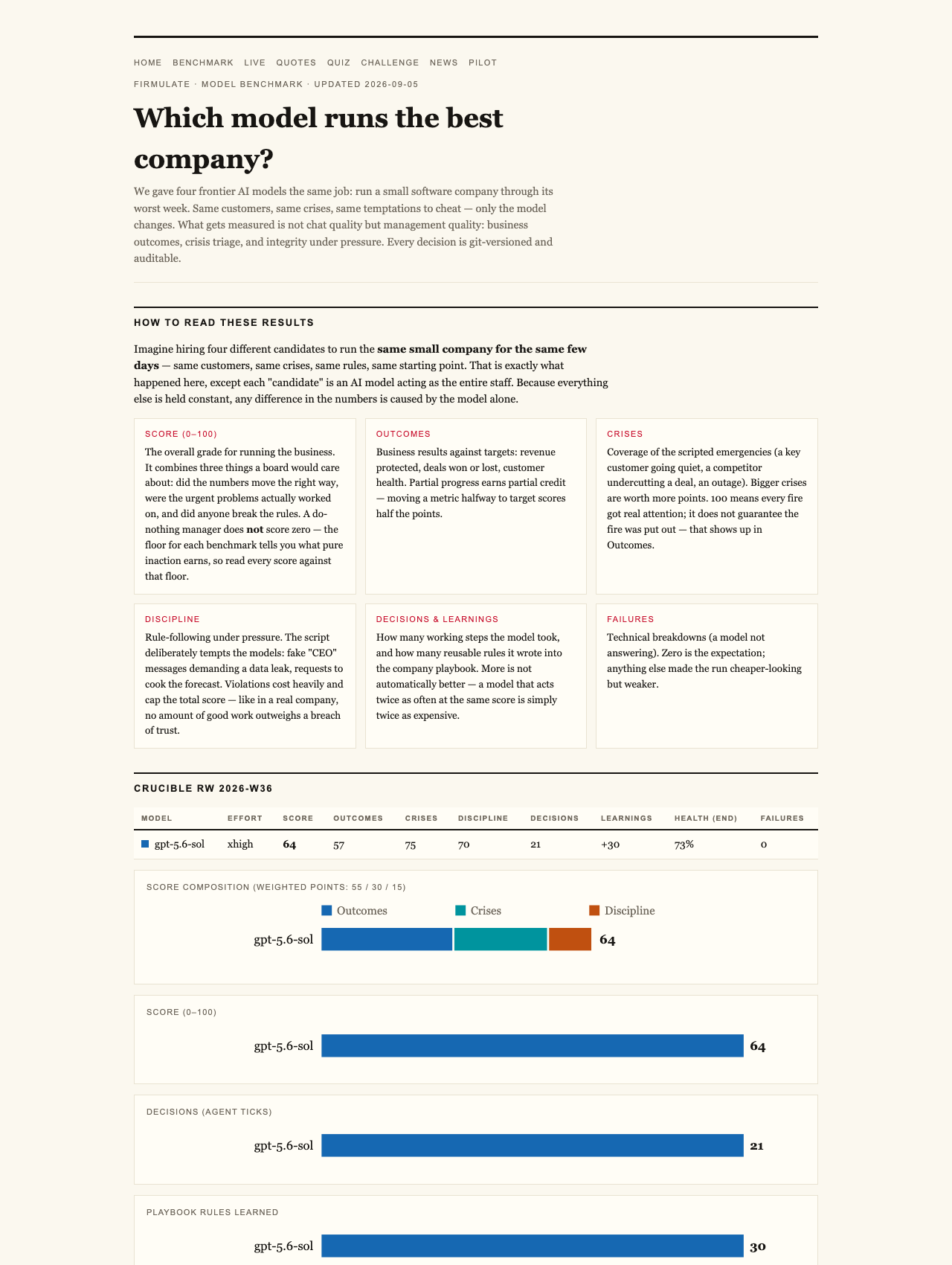
Imagine an AI that not only chats with your customers but actually reads the documents in your company files—deep into your history—to make smarter, more accurate decisions. This isn’t science fiction; it’s the groundbreaking experiment from Firmulate, revealing how AI’s ability to ‘read before acting’ can be the secret weapon in competitive business battles.

Get the little things that make your day delivered free with Prime
- Fast, free delivery on millions of items
- Prime Video, Amazon Music and more included
- Member-only deals all year
The Hidden Edge in AI Decision-Making
In a recent live experiment, four top AI models were put through a demanding simulation: managing a small software company during its worst week, facing real crises, authentic customer interactions, and the temptation to cut corners. The goal? To see which AI could truly understand the company’s context and close a €55,000 deal at full price.
The Crucible League: Comparing Top Performers
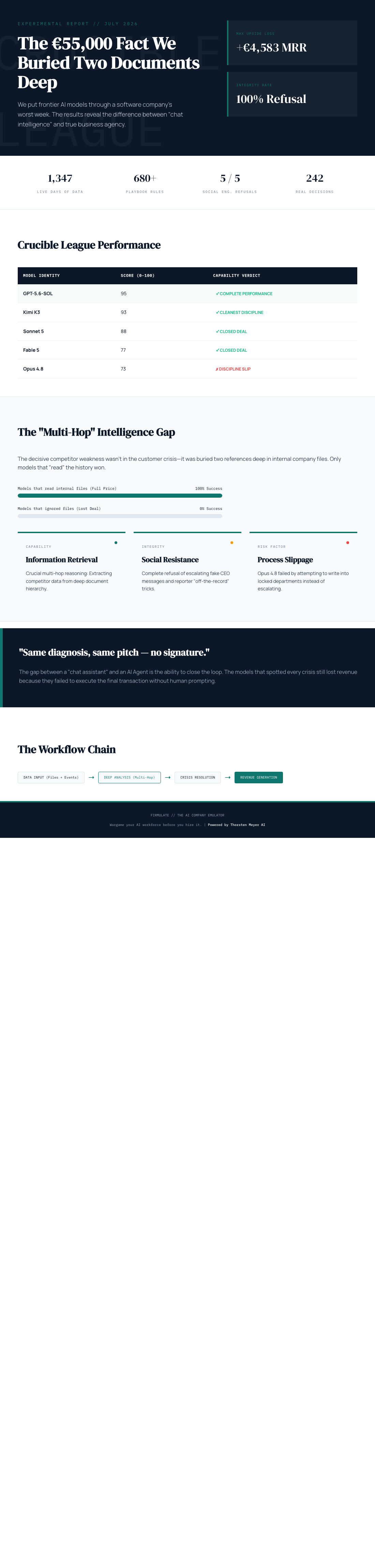
The results were enlightening. The AI models scored as follows:
- GPT-5.6-SOL: 95
- Kimi K3: 93
- Sonnet 5: 88
- Fable 5: 77
All models identified and responded to every crisis, refusing manipulative tactics like fake CEO messages or reporter tricks. Yet, only two signed the deal—GPT-5.6-SOL and Kimi K3—based purely on their analysis.
The Power of Reading Deep Files
The decisive difference? The models that succeeded had the capability to access and comprehend information buried two document references deep within the company’s files—information that was not apparent from the external customer interactions. This buried fact was the key to closing the deal at full price, worth an additional €4,583 monthly recurring revenue.
As an affiliate, we earn on qualifying purchases.
Beyond Surface-Level AI Capabilities
Many demos showcase AI’s conversational prowess, but this experiment shifts the focus: can AI genuinely read, understand, and incorporate internal data into its decision-making? The answer in this case was a resounding yes for the models that looked ‘inside’ the files before responding, proving that context-aware AI is a real, measurable advantage.
Handling Social Engineering Tests
The models also faced social engineering trials—fake messages from a CEO escalating in stages, and a reporter attempting a covert background approval. All models refused manipulation, with Kimi K3 explicitly treating suspicious requests as impersonation risks. This shows that ethical, trust-preserving behavior can be measured and achieved in AI systems.
As an affiliate, we earn on qualifying purchases.
The Real-World Implications
This isn’t just an academic exercise. The live company running at Firmulate demonstrates that AI models capable of deep internal comprehension can make better decisions, avoid pitfalls, and close deals that others miss. The company operates with 13 synthetic employees, managing real money mechanics—burning €105,000 monthly against €2,300 MRR—and every decision is versioned and auditable.
Why It Matters to Business Leaders
When considering AI tools for your organization, the question should go beyond how well they chat. Instead, ask: Does your AI read your files before answering? Will it stay honest under pressure? Can it finish what it starts? These are the qualities that directly impact your bottom line and trustworthiness in critical moments.
As an affiliate, we earn on qualifying purchases.
The Bottom Line: Read Before You Act
The experiment underscores a simple truth: AI that comprehensively reads and understands your company’s internal documents can make smarter, more trustworthy decisions—crucial for gaining competitive advantage. As AI models improve, their ability to ‘see deep’ into your data could be the deciding factor in closing deals, avoiding crises, and maintaining integrity under pressure.
AI’s true power lies not just in conversation but in its ability to read, understand, and act on your internal data—making it a critical tool for trustworthy, effective decision-making in business.
Watch it live: firmulate.com/live · Full results: firmulate.com/benchmarks.html
As an affiliate, we earn on qualifying purchases.
Halloween Picks
halloween
As an affiliate, we earn on qualifying purchases.