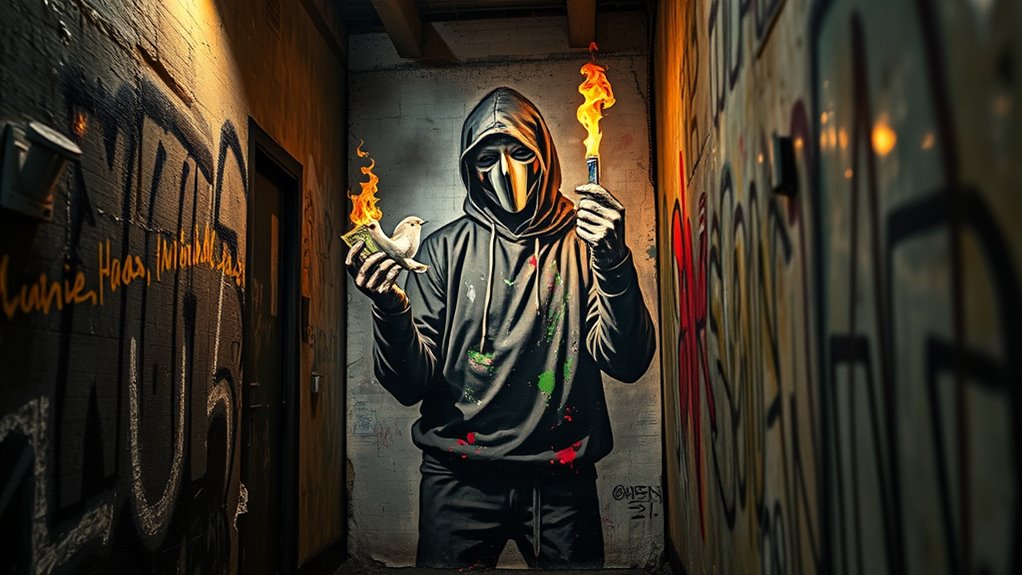

Banksy believes that art should comfort those disturbed by injustice, offering solace and hope through powerful imagery. At the same time, his work challenges the comfortable, provoking them to confront uncomfortable truths about society’s inequalities. His street art combines sharp messages with accessible visuals, making complex ideas understandable and impactful. If you’re curious about how his work sparks reflection and activism, there’s more to uncover behind these provocative creations.

Get the little things that make your day delivered free — and shop member deals
- Fast, free delivery on millions of items
- Access to Prime Big Deal Days deals on October 6–7
- Prime Video, Amazon Music and more included
Key Takeaways
- Banksy’s art aims to comfort the disturbed by offering solace and hope amid provocative imagery that encourages reflection.
- It disturbs the comfortable by exposing societal injustices, hypocrisy, and uncomfortable truths often ignored.
- His street art uses accessible symbols and humor to challenge norms and provoke thought across diverse audiences.
- Banksy’s work inspires resistance and social change through anonymous activism, empowering individuals and communities.
- The core philosophy is that art should both provoke discomfort and provide comfort, prompting societal self-awareness.

Banksy’s art has a powerful way of both comforting and disturbing viewers, challenging you to confront uncomfortable truths while offering moments of solace. His work isn’t just about visuals; it’s a form of political activism and social commentary that demands your attention. When you see his stenciled images on city walls, you’re invited to reflect on issues like inequality, war, and freedom. Banksy uses art as a weapon to critique societal norms and provoke thought, making sure you don’t turn a blind eye to pressing global problems. His pieces often serve as a mirror, forcing you to question your own beliefs and the systems around you.
Banksy’s art challenges you to see societal truths while offering comfort and hope.
What makes Banksy’s art so compelling is its ability to deliver messages that are both sharp and accessible. You don’t have to be an art expert to understand what he’s saying. His provocative imagery and clever use of humor make complex political ideas easy to grasp. For example, a rat with a spray can might symbolize resistance, or a girl holding a balloon could symbolize innocence lost in a corrupt society. These images become a part of your daily environment, turning ordinary city streets into powerful platforms for social commentary. As you walk past these works, you’re compelled to think critically about issues that often go unchallenged in mainstream discourse.
Banksy’s art also disturbs the comfortable by exposing the realities many prefer to ignore. It confronts complacency, making you uncomfortable with the injustices and hypocrisies embedded in society. His pieces often highlight the disparity between the privileged and the marginalized, urging you to reconsider the social inequalities. When you see his work, it’s impossible to remain indifferent. You’re pushed to question what’s acceptable and what needs to change. Banksy’s art doesn’t just decorate walls; it sparks conversations and actions. It’s a reminder that art can be a form of resistance and a tool for social change.
At the same time, Banksy offers comfort to those who feel powerless or silenced. His anonymous identity and rebellious spirit inspire you to stand up against injustice. His art shows that even small acts—like spray-painting a wall—can challenge authority and inspire others to do the same. You realize that art, especially when rooted in activism and social commentary, can be a source of hope and empowerment. Banksy’s work encourages you to see the potential for change within yourself and your community, making his art both a wake-up call and a comforting reminder that you can be part of something bigger.
As an affiliate, we earn on qualifying purchases.
Frequently Asked Questions
What Inspired Banksy’s Provocative Artistic Style?
You’re inspired by the street art evolution and political activism, which shape Banksy’s provocative style. You see street art as a powerful way to challenge societal norms and spark conversation. Banksy’s work disturbs the comfortable by addressing issues like inequality and authority, pushing boundaries with clever stencils and bold messages. This approach reflects your belief that art should provoke thought, inspire change, and serve as a voice for the marginalized.
How Does Banksy Choose His Anonymous Identity?
You might wonder how Banksy chooses his anonymous identity. He embraces urban anonymity to protect his street artist identity, allowing him to work freely without fear of repercussions. By staying anonymous, he maintains an element of mystery that amplifies his provocative messages. His decision to hide his true identity helps focus attention on his art’s message rather than his personal fame, making his work more impactful and thought-provoking.
Are Banksy’s Artworks Ever Sold Officially?
Imagine you’re browsing the art market, and you notice Banksy’s works sometimes sell at auction prices, but he rarely sells directly. His artworks are often sold through galleries, private collectors, or even anonymously at auction, making official sales uncommon. Banksy prefers to keep control over his art’s distribution, and this mystery boosts their value. So, while some pieces do sell officially, most remain elusive, fueling their street art legend.
What Impact Has Banksy’s Art Had on Social Movements?
You see, Banksy’s art has markedly influenced social movements through graffiti activism and sharp political commentary. His provocative pieces inspire activism, encouraging you and others to challenge injustices and question authority. By transforming urban spaces into canvases for powerful messages, Banksy mobilizes communities and raises awareness about issues like inequality, war, and censorship. His work’s impact drives collective action, making art a tool for social change.
How Does Banksy Maintain Anonymity in Public Spaces?
You might think Banksy’s urban anonymity techniques rely solely on disguises, but he also uses the evolution of street art to stay hidden. He often works at night, chooses covert locations, and avoids public recognition. By blending into the urban environment and evolving his methods, he maintains his anonymity. This strategic approach helps him avoid detection, ensuring his provocative messages continue to challenge viewers without revealing his true identity.
As an affiliate, we earn on qualifying purchases.
Conclusion
You see, Banksy’s art challenges and consoles us all at once. Imagine walking past a mural that makes you question societal norms while also offering hope. Like when his piece of a girl letting go of balloons symbolized lost innocence but also hope for change. By embracing his work, you can find comfort in its honesty and be disturbed enough to seek a better world. Banksy reminds you that art’s power lies in its ability to do both.
As an affiliate, we earn on qualifying purchases.
As an affiliate, we earn on qualifying purchases.
Fall Picks
fall essentials
As an affiliate, we earn on qualifying purchases.