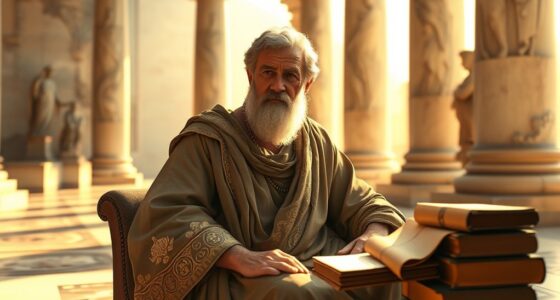

When you explore René Descartes’ famous statement, “I think, therefore I am,” you discover a core idea in philosophy. Descartes uses radical skepticism to doubt everything except his own thinking process. He finds that the very act of doubting confirms his existence. This insight establishes the mind as the foundation of knowledge. If you want to understand how Descartes separates mind from body and why rationality matters, there’s more to uncover beyond this key concept.
Key Takeaways
- Descartes’ famous statement “I think, therefore I am” affirms self-awareness as the only indubitable truth amid radical doubt.
- It establishes the certainty of the self’s existence through the act of thinking, serving as the foundation for all knowledge.
- The phrase emphasizes rationality as the primary means of understanding and verifying reality.
- It marks a shift from trusting sensory perception to relying on reason and introspection for truth.
- This principle underpins Descartes’ dualism, distinguishing the thinking mind from the physical body.

René Descartes was a pioneering philosopher and mathematician whose ideas laid the groundwork for modern science and philosophy. You might find his approach to understanding existence both intriguing and challenging. At the core of his philosophy lies a radical skepticism about what we can truly know. He questioned whether our senses could be trusted, leading him to develop epistemological skepticism — the idea that certainty about knowledge is elusive. This skepticism pushes you to doubt everything that isn’t absolutely clear and certain, including the existence of the physical world. It’s through this process that Descartes arrives at his famous conclusion: “I think, therefore I am.” This statement becomes the foundation for his entire philosophy because it’s the only thing he can be certain of amidst doubt.
Descartes’ radical doubt leads to the certainty of self-existence: I think, therefore I am.
Descartes’s exploration of mind and body introduces the concept of mind-body dualism. You might see this as a way of distinguishing between two fundamentally different substances: the immaterial mind and the physical body. He argues that your mind — your thoughts, beliefs, and consciousness — is separate from your body, which is extended in space and governed by physical laws. This dualism means that mental phenomena aren’t reducible to physical processes; instead, they interact but remain distinct. This idea challenges you to think about how your mental experiences relate to your physical existence. It raises questions about the nature of consciousness and whether your mind can exist independently of your body. Descartes believed that understanding this separation was essential for developing a clearer picture of reality. Additionally, his emphasis on rationality highlights the importance of reason as the primary tool for acquiring knowledge and understanding the world.
His emphasis on epistemological skepticism also shapes how you approach knowledge. Descartes urges you to doubt everything that can be questioned until you find something indubitable. This method leads him to focus on the certainty of your own thinking as the starting point for building knowledge. You’re encouraged to think critically about the foundations of what you believe to be true, recognizing that many assumptions may be flawed. By doing so, he aims to establish a firm ground for science and philosophy, one that’s built on undeniable truths. His approach influences countless thinkers and scientific methods that prioritize evidence and rational certainty.
In essence, Descartes’s ideas challenge you to examine your own existence and the nature of reality through doubt and reason. His mind-body dualism offers a framework for understanding how mental and physical phenomena coexist, while his epistemological skepticism pushes you to seek certainty above all else. Together, these concepts form a legacy that continues to shape modern thought, urging you to question, analyze, and seek clarity in your pursuit of truth.

The Complete Works of Rene Descartes: Discourse on the Method, Meditations on First Philosophy & More (Grapevine Edition) (The Masters of Philosophy Collection: Timeless Writings)
As an affiliate, we earn on qualifying purchases.
As an affiliate, we earn on qualifying purchases.
Frequently Asked Questions
How Did Descartes Influence Modern Scientific Methodology?
You see, Descartes influenced modern scientific methodology by emphasizing rational analysis and skepticism, which encourages you to question assumptions critically. He promoted empiricism by relying on clear, logical reasoning and doubt to establish certainty. His approach pushes you to verify ideas through evidence rather than blind acceptance, fostering a systematic way of investigating the world that underpins scientific inquiry today. This blend of skepticism and empiricism shapes how you approach experiments and hypotheses.
What Were Descartes’ Views on Religion and Faith?
You might find that Descartes approached faith with skepticism, questioning traditional religious influences. He believed reason and evidence should guide understanding, rather than unquestioning faith. While he valued religion, he also sought a clear distinction between science and religious doctrine. His views encouraged a more rational approach to spirituality, promoting individual inquiry over dogma, which profoundly shaped modern attitudes toward religion and faith in the context of scientific progress.
Did Descartes Have Any Notable Students or Followers?
You should know that René Descartes didn’t have any widely recognized students or followers, but his Cartesian legacy profoundly influenced later thinkers. His philosophical mentorship shaped modern rationalism, inspiring many to pursue critical thinking and scientific method. Although he worked largely alone, his ideas laid the groundwork for Enlightenment philosophy. You can see his lasting impact in the development of modern philosophy, science, and mathematics, even without direct mentorship.
How Did Descartes’ Ideas Impact Later Philosophers?
Descartes’ ideas revolutionized philosophy by emphasizing mind-body dualism and promoting epistemological skepticism. You see, his focus on separating the mind from the body challenged existing views and inspired later thinkers to explore consciousness and the nature of reality. His skepticism about knowledge pushed others to question assumptions, leading to new methods in scientific inquiry and philosophy. Ultimately, his work laid the groundwork for modern discussions on mind, knowledge, and existence.
What Was Descartes’ Personal Life Like Outside Philosophy?
You learn that Descartes came from a well-off family with a background in law and military service. Outside philosophy, he enjoyed personal hobbies like horseback riding, which helped him relax and think deeply. He traveled extensively across Europe, often seeking quiet places for reflection. His family background and hobbies influenced his disciplined yet adventurous life, shaping his approach to both philosophy and personal pursuits.

Human Body Activities & Experiments Science Kit for Kids,Human Anatomy Body Parts with Broken Bones X Ray,Lung Breathing Model, Vessels, Digestive System,Muscles Model,Skeleton,Human Organ STEM 5+
HANDS-ON LEARNING: Explore the human body parts, create and learn how to identify multiple organs, and discover x-rays…
As an affiliate, we earn on qualifying purchases.
As an affiliate, we earn on qualifying purchases.
Conclusion
You now see how René Descartes’s famous statement, “I think, thus I am,” revolutionized philosophy. Did you know that over 60% of college students recognize this phrase? It shows how his idea still influences modern thinking. By questioning everything, Descartes reminds you to trust your reasoning. Keep exploring, and remember that your ability to think is proof of your existence. This simple yet profound idea continues to inspire generations worldwide.

Critical Thinking: Tools for Evaluating Research
As an affiliate, we earn on qualifying purchases.
As an affiliate, we earn on qualifying purchases.

INSIDE THEN OUT Better Every Day Journal – Guided Daily Journal With 365 Pre-Dated Prompts for Self Love, Reflection, Growth, Gratitude, Discovery, Wellness, Healing, Self Help, and Mindfulness – Self Care Routine & Mental Health Gift for Women Men
Guided Daily Journal: 365 thoughtful prompts designed for self-love, reflection, and growth. Get to know yourself on a…
As an affiliate, we earn on qualifying purchases.
As an affiliate, we earn on qualifying purchases.