

Mark Twain believed that formal schooling isn’t enough for true education. He valued curiosity, independence, and practical experiences over traditional classes. By exploring outside the classroom and learning from real-life situations, he developed critical thinking and a deep understanding of people. Twain’s words suggest that life itself teaches us more than any school can. If you keep exploring, you’ll discover even more about how real learning happens beyond the classroom walls.
Key Takeaways
- Twain believed true education comes from independent learning, not just formal schooling.
- He valued practical skills and real-world experiences over traditional classroom methods.
- His self-directed exploration helped develop critical thinking and adaptability.
- Formal education was inconsistent for him, but he learned through reading, observation, and hands-on work.
- Twain emphasized that life experiences and curiosity are essential components of meaningful education.
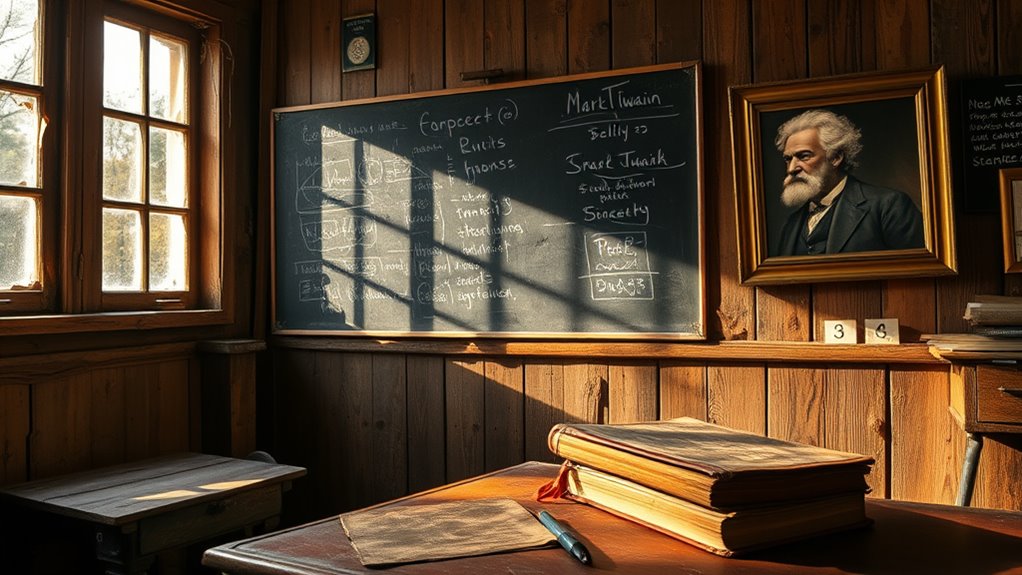
Have you ever wondered how Mark Twain’s early schooling shaped his later writing? It’s a fascinating question because Twain’s own words suggest he didn’t see traditional education as the key to his success. Instead, he valued learning independence and acquiring practical skills that he could apply in real life. From a young age, Twain learned that relying solely on formal schooling wouldn’t make him a well-rounded person or a talented writer. His experiences show that education isn’t just about memorizing facts; it’s about developing the ability to think critically and adapt to different situations.
Mark Twain valued independence and practical skills over traditional education for success and growth.
Twain’s early education was inconsistent and often disrupted by financial struggles and frequent moves. Despite these setbacks, he found ways to learn outside the classroom, emphasizing independence in his learning process. You might say that he became self-reliant, seeking out knowledge on his own, whether through reading books, exploring nature, or engaging with people from diverse backgrounds. This self-directed learning helped him cultivate a curious mind and a keen sense of observation—traits that later enriched his storytelling. Instead of passively absorbing lessons, Twain took charge of his education, which allowed him to learn at his own pace and focus on what genuinely interested him.
Moreover, Twain’s focus on practical skills played a significant role in shaping his worldview. He learned skills that were useful in everyday life—farming, printing, and working as a riverboat pilot—all of which gave him a broad perspective and a deep understanding of human nature. These experiences outside the classroom provided him with real-world insights that he later infused into his writing. You can see how this emphasis on practical skills helped him connect with ordinary people and craft stories that resonated with a wide audience. Twain believed that education should prepare you for life, not just for passing tests or memorizing dates.
His approach to learning teaches us that education isn’t confined to school walls. It’s about curiosity, independence, and applying knowledge practically. Twain’s life shows that even if formal schooling is limited or imperfect, you can still become well-educated through self-motivation and real-world experience. His success proves that learning independence and practical skills can be just as crucial—if not more so—than traditional education. By valuing these qualities, you can foster your own growth, develop a sharp mind, and prepare yourself for whatever challenges lie ahead. Twain’s journey reminds us that the most meaningful education often comes from life itself, not just the classroom.
Frequently Asked Questions
Did Mark Twain Ever Attend College or University?
You might think Mark Twain had formal credentials or an extensive academic background, but he never attended college or university. Instead, he gained his knowledge through self-education, reading widely, and real-life experiences. Twain believed that formal schooling often limited learning, which is why he emphasized the importance of personal curiosity and practical knowledge. So, his education was unconventional, relying on life lessons rather than traditional academic credentials.
How Did Twain’s Informal Learning Influence His Writing Style?
Your informal learning had a massive impact on Twain’s writing style, shaping it in extraordinary ways. By exploring life directly and learning outside classrooms, he gained a creative influence that made his language lively, humorous, and authentic. This informal approach allowed him to craft stories filled with wit and realism, proving that true education often comes from experience rather than formal schooling, and it’s what made his voice so uniquely compelling.
What Specific Lessons Did Twain Learn Outside of Formal Schooling?
You learn valuable life lessons and practical skills outside school by exploring the world firsthand. Twain’s experiences as a steamboat pilot, miner, and traveler teach you resilience, adaptability, and humor. These lessons shape your understanding of human nature and society. You discover that real-world experiences often teach more than textbooks, helping you develop a unique voice and perspective that enrich your writing and personal growth.
Did Twain Ever Regret His Unconventional Education Methods?
You might wonder if Twain ever regretted his unconventional education methods. He believed that formal schooling often limited his real learning, preferring hands-on experiences like exploring the Mississippi River. If you imagine him skipping class to read or write stories, you’d see he valued practical lessons over rigid rules. Twain didn’t regret his approach; he saw it as essential to his creativity and success, proving that unconventional education can be powerful.
How Did Twain’s Schooling Experiences Shape His Views on Education?
Your schooling experiences, marked by limited formal schooling and rich informal learning, shaped your views on education. You believe that strict, formal schooling can hinder true understanding, so you value practical, real-world experiences more. This perspective encourages you to seek knowledge outside traditional classrooms, emphasizing the importance of informal learning. Your experiences lead you to see education as a personal journey rather than just a structured, institutional process.
Conclusion
You might be surprised to learn that Mark Twain once said, “I never let my schooling interfere with my education,” highlighting the difference between formal lessons and real-world learning. Studies show that only 10% of what you learn in school sticks, making Twain’s point even more relevant today. So, remember, true education comes from life experiences, curiosity, and seeking knowledge beyond textbooks. Keep exploring and learning, and you’ll find education truly enriching.

Joy, as our Editor in Chief, ensures the highest standard of content. Her talent in writing is complemented by her attention to detail and passion for literature and culture. Joy’s expertise and love for the English language shine through in her editorial work, making each piece a testament to quality and clarity.