
Leonardo da Vinci saw painting as a form of visual poetry, where every brushstroke and symbol tells a story layered with emotion and meaning. He believed that light, shadow, and symbolic elements work together like words and verses to evoke feelings beyond words. His art invites you to interpret deeper truths beneath the surface, creating a silent language of symbols and emotion. If you keep exploring his work, you’ll discover how he transforms images into poetic expressions of human experience.
Key Takeaways
- Leonardo viewed painting as a visual poetry that communicates complex emotions and ideas through symbolism and imagery.
- His mastery of chiaroscuro enhances the poetic depth by emphasizing contrasts of light and shadow.
- Symbols like gestures, backgrounds, and facial expressions serve as a visual vocabulary, telling layered stories.
- Paintings evoke feelings and truths beyond words, functioning as silent, poetic expressions of human experience.
- Overall, Leonardo’s art creates a harmonious visual language that invites viewers into a deeper emotional and interpretive dialogue.
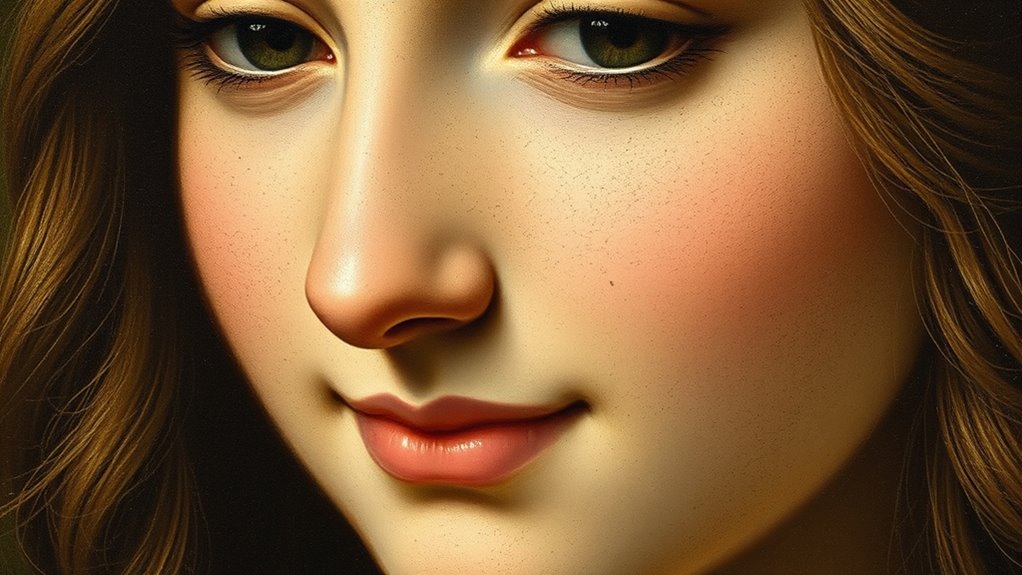
Leonardo da Vinci’s paintings are often regarded as visual poetry, capturing the subtle beauty and complexity of human emotion in a single glance. When you observe his work, you realize that each brushstroke is deliberate, serving as a form of symbolic imagery that conveys more than what meets the eye. Da Vinci believed that art should tell a story, not just depict a scene; his paintings are masterful examples of visual storytelling that invite you to interpret layers of meaning beneath the surface. The Mona Lisa, for instance, isn’t just a portrait but a tapestry of subtle clues—her enigmatic smile, the atmospheric background, and the delicate play of light and shadow all work together as a form of poetic language. You sense that there’s a story behind her gaze, one that transcends simple representation and invites you into a deeper dialogue about human emotion and mystery.
In Leonardo’s view, paintings are a form of poetry because they communicate through symbolism. Every element in his compositions holds significance—flowers, landscapes, gestures, and facial expressions all serve as symbols that enrich the narrative. These symbols act as a visual vocabulary, allowing you to read the painting much like a poem, where each word and line contributes to the overall meaning. His use of symbolic imagery isn’t arbitrary; it’s a carefully crafted language designed to evoke feelings and ideas that words often struggle to express. As you study his work, you notice how these symbols work together to create a harmonious whole—a visual poem that speaks directly to your senses and subconscious. Furthermore, his mastery of chiaroscuro enhances this poetic effect by emphasizing contrasts that deepen emotional resonance.
Da Vinci’s approach to painting emphasizes the importance of capturing the essence of human experience, making his art a form of poetic expression. His mastery of chiaroscuro—the contrast of light and dark—adds depth and emotion, guiding your eye through the narrative he’s woven into the canvas. You recognize that every shadow, highlight, and subtle gradation contributes to the emotional tone, much like the rhythm and cadence of a poem. Through this visual storytelling, da Vinci invites you to see beyond the surface, to read the silent language of symbols and emotions that he embedded in his work. His paintings are, consequently, not just images but poetic expressions that speak directly to your soul, allowing you to experience the profound beauty of human life in a single, evocative glance.

DECORARTS – Mona Lisa by Leonardo DaVinci. The World Classic Art Reproductions. Giclee Print& Museum Quality Framed Art for Wall Decor. Framed size: 22×30
Mona Lisa is known as the most mysterious smile once in a life. Whatever which side you look…
As an affiliate, we earn on qualifying purchases.
As an affiliate, we earn on qualifying purchases.
Frequently Asked Questions
How Did Leonardo Da Vinci’s Poetry Influence His Paintings?
Your understanding of Leonardo da Vinci’s poetry reveals how it influences his paintings through symbolic language and poetic symbolism. By blending poetic ideas with visual elements, he expresses complex emotions and themes. You see this in his use of subtle gestures and allegorical details, making his art feel like visual poetry. This poetic symbolism invites viewers to interpret deeper meanings, creating a harmonious connection between his poetic words and masterful paintings.
What Specific Techniques Connect Da Vinci’s Poetry and Visual Art?
Did you know that Da Vinci’s sketches contain over 13,000 pages filled with visual metaphors? You’ll notice he uses symbolic harmony to connect ideas in both his poetry and paintings. His techniques intertwine imagery and symbolism, creating layered meanings. This approach allows his art to evoke emotion and intellect, much like poetry. By blending visual metaphor with careful composition, Da Vinci transforms simple images into profound storytelling devices.
Are There Surviving Poems Written by Leonardo Da Vinci?
You’ll find that there are some surviving poems written by Leonardo da Vinci within historical manuscripts. These texts reveal his poetic side, often explored through literary analysis to understand his thoughts and creativity. While not as numerous as his artworks, these poems provide insight into his mind and connect his visual art to poetic expression, showcasing how he blended artistic disciplines seamlessly.
How Does Da Vinci’s Concept Compare to Other Renaissance Artists?
You see, Da Vinci’s artistic philosophy emphasizes blending poetic symbolism with visual art, making his work feel like a poetic dialogue. Unlike many Renaissance artists who focused on realism or religious themes, Da Vinci sees painting as a form of poetry you can see, inviting viewers to interpret deeper meanings. His approach sets him apart, as he treats each piece as a poetic expression, enriching the viewer’s experience beyond mere visual beauty.
Can Da Vinci’s Approach Be Applied to Modern Art Forms?
You can definitely apply Da Vinci’s approach to modern art forms by embracing poetic visualization and fostering artistic innovation. By viewing art as a form of visual poetry, you encourage deeper emotional and intellectual connections. This perspective challenges you to blend technique with meaning, creating works that resonate on multiple levels. Incorporating Da Vinci’s ideas helps you push boundaries, making your art more expressive, thoughtful, and impactful in today’s diverse artistic landscape.

The Chiaroscuro Woodcut in Renaissance Italy
As an affiliate, we earn on qualifying purchases.
As an affiliate, we earn on qualifying purchases.
Conclusion
You now see how Leonardo da Vinci saw painting as poetry—every brushstroke a carefully chosen word, every detail a meaningful line. His art invites you to look beyond the surface and feel the story behind each image. Just remember, beauty lies in the eye of the beholder, and with Da Vinci’s approach, you get to see the poetry woven into every masterpiece. It’s a reminder that true art speaks where words often fall short.

97 Decor Vintage Eclectic Wall Art Collage – Abstract Modern Art Prints For Wall Decor, Cool Funky Pictures Maximalist Paintings Retro Bauhaus Posters Set For Dorm Bedroom Home Decorations (Unframed)
Eclectic Decor: Elevate your living space with gallery wall art set, a perfect blend of retro wall art…
As an affiliate, we earn on qualifying purchases.
As an affiliate, we earn on qualifying purchases.

Poster Master Poetry And Language Poster – Amanda Gorman Print – Motivational Art – Change Quotes Art – Gift for Men & Women – Inspiring Wall Decor for Living Room or Office – 8×10 UNFRAMED Wall Art
✅UNFRAMED PRINTS: We create all our prints in variation of standard sizes from 8×10 to 24×32 inches. For…
As an affiliate, we earn on qualifying purchases.
As an affiliate, we earn on qualifying purchases.