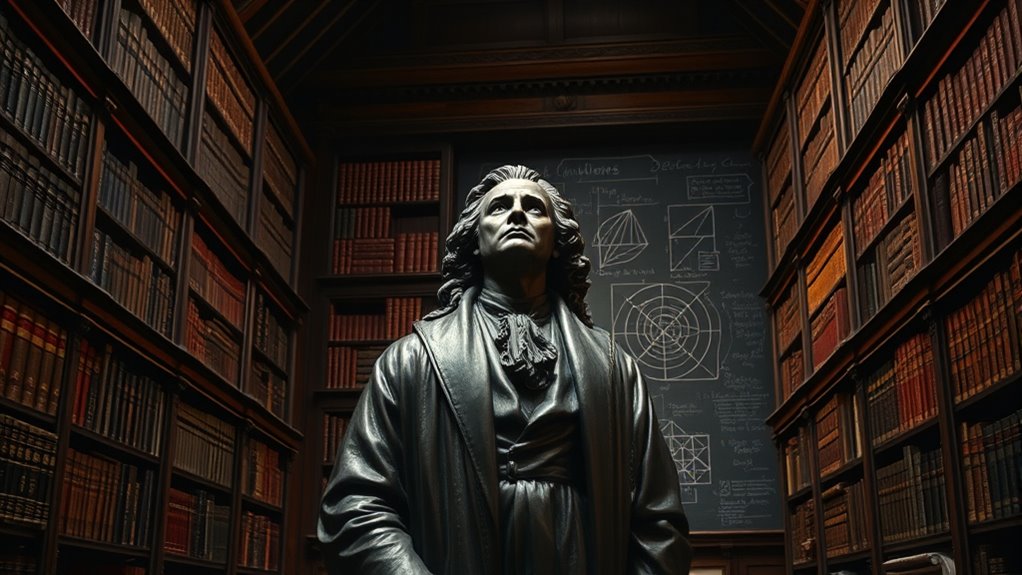

Isaac Newton’s quote shows how scientific progress builds on previous ideas. You learn that he didn’t work alone but combined earlier discoveries to create groundbreaking theories like calculus and the law of universal gravitation. His work transformed understanding of the universe by applying rigorous math to explain motion and gravity. If you explore further, you’ll see how Newton’s collaboration and innovations laid the foundation for modern science and collective knowledge.
Key Takeaways
- Newton acknowledged that his discoveries built upon previous scientists’ work, emphasizing the importance of scientific collaboration.
- His development of calculus and laws of motion advanced understanding by synthesizing prior ideas into a cohesive framework.
- The phrase highlights that scientific progress depends on standing on the shoulders of earlier thinkers.
- Newton’s *Principia* unified celestial and terrestrial physics, showcasing cumulative knowledge’s power.
- His legacy demonstrates how collective insights and building on others’ work drive scientific breakthroughs.

Isaac Newton was a groundbreaking scientist whose work laid the foundation for modern physics and mathematics. His contributions marked a pivotal moment in history, sparking what is known as the scientific revolution. You might think of Newton as a figure who transformed how we understand the universe, but his achievements didn’t happen in isolation. Instead, he built upon the ideas of previous thinkers, standing on the shoulders of giants. This collaborative progression fueled revolutionary changes that continue to influence science today. Newton’s work exemplifies how scientific discoveries are rarely solitary moments; they are the result of cumulative insights that push humanity forward.
Isaac Newton’s groundbreaking work built on previous ideas, exemplifying how scientific progress is a collective, collaborative effort.
During this scientific revolution, Newton introduced mathematical breakthroughs that changed the way we approach natural phenomena. His development of calculus, independently discovered alongside Leibniz, provided a powerful tool for analyzing change and motion. You can see how this was revolutionary—calculus allowed scientists to describe the laws of motion and gravity with unprecedented precision. These mathematical breakthroughs didn’t just improve existing models; they created entirely new ways of understanding the physical world. They enabled scientists to quantify forces, trajectories, and planetary movements, making predictions that were previously impossible. This leap in mathematical capability is what set Newton apart and allowed him to formulate his laws with confidence and clarity.
Newton’s famous work, *Principia Mathematica*, epitomizes these advancements. In it, he formulated the law of universal gravitation, explaining how every object in the universe attracts every other object with a force proportional to their masses and inversely proportional to the square of the distance between them. This law unified celestial and terrestrial physics under one framework, revolutionizing how we see the universe. By applying rigorous mathematics to physical laws, Newton didn’t just describe nature—he explained it. His integration of mathematics and empirical observation created a new paradigm, transforming scientific inquiry from a qualitative craft into a precise, quantitative science. Furthermore, Newton’s work was built on the earlier scientific ideas that shaped his thinking, demonstrating the importance of scientific collaboration in making groundbreaking discoveries.
As you reflect on Newton’s legacy, realize that his achievements were built on the groundwork laid by countless predecessors. Yet, his ability to synthesize existing ideas into a cohesive framework marked a real turning point. His mathematical breakthroughs provided the language and tools for future scientists to explore further. Newton’s work exemplifies how standing on the shoulders of giants can lead to new heights of discovery, and how the scientific revolution reshaped our understanding of the universe forever. His legacy invites you to appreciate the importance of collaboration, innovation, and the relentless pursuit of knowledge.
scientific calculator for students
As an affiliate, we earn on qualifying purchases.
As an affiliate, we earn on qualifying purchases.
Frequently Asked Questions
What Are the Main Contributions of Isaac Newton to Science?
You see Newton’s main contributions in celestial mechanics, where he formulated the laws of motion and universal gravitation, explaining planetary movements. Additionally, his optical innovations transformed our understanding of light and color through his work with prisms. These breakthroughs revolutionized physics and astronomy, laying the foundation for modern science. His insights continue to influence how we comprehend the universe, making him one of history’s most influential scientists.
How Did Newton Develop His Theories of Gravity and Motion?
You’ve got to see Newton’s approach as revolutionary—he developed his theories of gravity and motion through meticulous experimental methods and groundbreaking mathematical modeling. By observing how objects fall and applying calculus, he formulated laws that describe motion and universal gravitation. His insights came from testing ideas, analyzing data, and using math to predict phenomena, transforming how we comprehend the universe forever.
What Was Newton’s Impact on Later Scientific Discoveries?
Newton’s scientific legacy profoundly influences modern physics, shaping how you understand gravity, motion, and the universe. His groundbreaking laws serve as the foundation for countless discoveries and innovations. You see his impact in fields like aerospace, engineering, and technology. His work empowers scientists today to explore cosmic phenomena, proving how essential his contributions are to advancing science and expanding human knowledge.
How Did Newton’s Work Influence Other Scientific Thinkers?
Your understanding of Newton’s influence is colossal, shaping scientific thought across generations. His work profoundly impacted other thinkers by providing a solid foundation within the historical context of the Scientific Revolution. His philosophical approach to gravity and motion inspired future scientists to challenge assumptions and seek deeper truths. You see, Newton’s ideas didn’t just advance science—they revolutionized how thinkers approach the universe, making his influence feel truly astronomical.
What Controversies or Challenges Did Newton Face During His Career?
You face controversies during Newton’s career, including intense scientific rivalries with figures like Leibniz over calculus. Religious controversies also challenged him, as his beliefs clashed with mainstream church doctrines, leading to accusations and disputes. These conflicts tested his reputation but didn’t stop his groundbreaking work. Instead, they pushed him to defend his ideas vigorously, shaping the way science and religion interacted for generations.

The Principia: The Authoritative Translation and Guide: Mathematical Principles of Natural Philosophy
As an affiliate, we earn on qualifying purchases.
As an affiliate, we earn on qualifying purchases.
Conclusion
So, you stand on Newton’s shoulders, yet it’s ironic that even the greatest minds need others to see further. His famous words remind you that progress isn’t solo; it’s built on shared insight. While he claimed to see further, it’s clear he understood no one does it alone. Sometimes, the biggest discoveries come not from individual brilliance, but from the collective effort you’re all part of—standing on shoulders that lift us all higher.

Calculus For Dummies (For Dummies (Lifestyle))
As an affiliate, we earn on qualifying purchases.
As an affiliate, we earn on qualifying purchases.

Physics (Quick Study Academic)
As an affiliate, we earn on qualifying purchases.
As an affiliate, we earn on qualifying purchases.