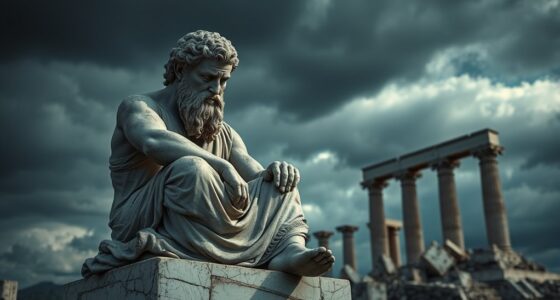

Heraclitus’s statement means that everything around you, like a river, is constantly changing, so you can never step into the same river twice. Each moment brings new flow, new perspectives, and new experiences. Trying to hold onto stability is futile because change is inevitable. Embracing this flux helps you adapt and see life’s beauty in its ongoing movement. If you continue exploring, you’ll discover how this idea shapes our understanding of reality and personal growth.
Key Takeaways
- Heraclitus’ quote emphasizes the constant change and flux inherent in the universe.
- It highlights that both the river’s water and our perceptions are always in motion.
- The statement illustrates that no situation or experience remains static over time.
- Recognizing perpetual change helps us adapt and accept life’s unpredictability.
- The quote symbolizes the continuous personal and existential journey of transformation.

Heraclitus famously claimed that “you cannot step into the same river twice,” emphasizing the constant change inherent in the universe. When you think about it, this idea pushes you to recognize that everything around you is in perpetual flux. The river’s water is always flowing, never static, just as your experiences and surroundings are continually shifting. This flux change isn’t just about physical movement; it shapes how you perceive the world. What you see today might look different tomorrow because both you and the environment are in constant transformation. Heraclitus invites you to realize that stability is an illusion, and change is the only constant. Your perception shift becomes inevitable as your understanding deepens; what once seemed fixed now appears fluid and evolving. Recognizing the importance of perpetual change helps you adapt more effectively to life’s unpredictability.
As you observe that river, you begin to see that it’s not the same water flowing past each moment, but a series of fleeting instances. This awareness prompts a shift in your perception. You realize that attempting to grasp or hold onto something static is futile because everything is transient. Heraclitus’s philosophy reminds you that your mind must adapt to this reality, embracing change rather than resisting it. When you accept flux change as an intrinsic aspect of existence, you become more flexible in your thinking and less attached to permanence. Your perception shifts from seeking stability to appreciating the beauty of constant movement, helping you understand life’s natural ebb and flow.
This perspective fundamentally alters how you approach life’s challenges. Instead of fearing change or clinging to what’s familiar, you learn to navigate uncertainty with resilience. Heraclitus’s insight teaches you to see the world as a dynamic process, where nothing remains the same for long. Every moment offers a new perspective, a fresh opportunity for growth. Recognizing this, you stop trying to control the uncontrollable and instead flow with the currents of life. The river becomes a metaphor for your own journey—always moving, never static, inviting you to embrace the ongoing process of transformation. By accepting flux change, you cultivate a mindset that values adaptability and openness, making each experience richer and more meaningful. Heraclitus’s timeless wisdom encourages you to see change not as a threat, but as the very essence of your existence.
Top picks for "heraclitu ever step"
Open Amazon search results for this keyword.
As an affiliate, we earn on qualifying purchases.
Frequently Asked Questions
How Does Heraclitus’s Philosophy Influence Modern Thought?
Heraclitus’s philosophy influences modern thought by emphasizing the flux nature of reality and constant change. You see this in science, where understanding that everything is in perpetual motion shapes theories about the universe. It also impacts personal growth, encouraging adaptability and acceptance of change. By recognizing that nothing remains static, you learn to embrace life’s evolving nature and develop resilience amidst ongoing transformations.
What Are Some Real-World Examples of Heraclitus’s Doctrine Today?
Imagine standing by a river, watching its flow constantly change—just like your personal identity shifts over time. This reflects Heraclitus’s doctrine that the river flow symbolizes life’s perpetual change. Today, you see this in technology, where digital profiles evolve, or in relationships, which grow and transform. You adapt continuously, much like stepping into the river again, knowing that both you and the world are always in flux.
How Did Heraclitus’s Ideas Compare to Those of His Contemporaries?
You see that Heraclitus believed in constant change and flux, contrasting sharply with his contemporaries who valued stability and permanence. While others sought unchanging truths, he argued that everything is in perpetual transformation. You can compare his ideas to modern views of dynamic systems, where change and flux are fundamental. Heraclitus’s focus on flux challenges the notion of fixed realities, highlighting that stability is often an illusion amid ongoing change.
Are There Any Criticisms or Limitations of Heraclitus’s Philosophy?
You might find philosophical criticisms of Heraclitus’s ideas revolve around their abstract nature and difficulty in practical application. Critics argue that his emphasis on constant change makes it hard to establish stable knowledge or moral principles. The practical limitations include its challenge to everyday decision-making and planning, as it’s tough to navigate a world perceived as perpetually in flux. These criticisms highlight that Heraclitus’s philosophy may be more insightful than directly applicable.
How Was Heraclitus’s Philosophy Received During His Lifetime?
Ever wonder how Heraclitus’s ideas were received during his lifetime? You might be surprised to learn that the public reception was mixed; some appreciated his innovative view of constant change, while others found his philosophy confusing. His ideas sparked philosophical debates, with critics questioning whether his fluid perspective truly explained reality. Despite the controversy, Heraclitus influenced many thinkers and left a lasting mark on early Greek philosophy.
Conclusion
Just as Heraclitus reminds us that you can never step into the same river twice, remember that life constantly flows and changes. Like a whispered echo of Heraclitus’s wisdom, this truth urges you to embrace the present, knowing it’s fleeting. So, stay curious and adaptable, for the river of life is forever in motion—ever-changing, yet always beautiful in its endless, flowing dance.