
Paul Klee’s statement that “art does not reproduce the visible” invites you to see beyond literal portrayals. Instead of focusing on realistic depictions, he encourages you to explore art as a way to express emotion, mood, and inner experience. His approach aligns with abstract expressionism, which emphasizes the unseen and personal. If you want to discover how art can evoke internal responses and transcend surface appearances, there’s more to uncover here.
Key Takeaways
- Klee’s statement challenges the idea that art merely copies visual reality, emphasizing art’s expressive and transcendent potential.
- It aligns with abstract expressionism, prioritizing emotion, mood, and internal experience over realistic representation.
- Klee encourages perceiving art through symbols and feelings, fostering internal interpretation beyond physical appearances.
- Art serves as a language of the subconscious, conveying complex emotions and ideas without literal depiction.
- The focus shifts from reproducing the visible to evoking internal responses, highlighting art’s power in internal exploration.
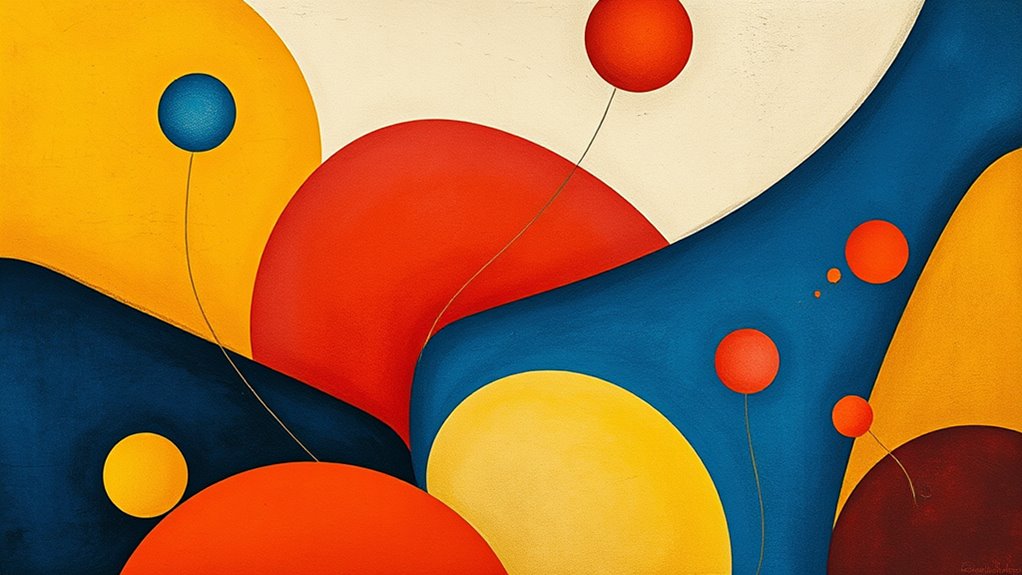
Paul Klee’s statement that “art does not reproduce the visible” challenges us to rethink what art can be. Instead of merely copying what our eyes see, Klee invites you to explore how art can transcend literal representation. This perspective aligns with the principles of abstract expressionism, where artists move away from realistic depictions and focus on conveying emotion, mood, and inner experience. In this sphere, visual perception shifts from a straightforward process of observing the physical world to engaging with a more subjective interpretation. You begin to see that art isn’t just about capturing the surface but about expressing the unseen, the intangible, and the personal.
Art transcends mere surface; it reveals the unseen through emotion and subjective interpretation.
When you look at a Klee painting, you’re not just observing a scene or object. Instead, you’re invited into a world where colors, shapes, and lines serve as symbols or emotional cues. His work defies traditional realism, urging you to perceive beyond surface appearances. This approach challenges your understanding of visual perception itself. You’re prompted to consider how your mind interprets visual stimuli—how your perceptions are shaped by feelings, memories, and subconscious impressions. Klee’s art encourages you to see with your mind’s eye, not just your physical eyes, emphasizing that perception is an active, interpretative process.
In embracing abstract expressionism, Klee emphasizes that art is a language of the subconscious and emotion. It’s less about replicating reality and more about evoking a response. As you engage with his work, you recognize that shapes and colors become symbols rather than mere representations. This shifts your focus from trying to decipher a literal scene to experiencing the artwork’s emotional resonance. You understand that visual perception is subjective—what you see is filtered through your own internal landscape, making each encounter with art a unique, personal journey.
Klee’s philosophy pushes you to reconsider your assumptions about art’s purpose. Instead of viewing it as a mirror of the visible world, you see it as a tool for internal exploration and expression. His emphasis on abstract expressionism demonstrates that art can communicate complex feelings and ideas without relying on realistic depiction. It challenges you to look deeper, to interpret beyond the surface, and to appreciate that the true power of art lies in its ability to evoke and provoke internal responses. Ultimately, Klee’s insight transforms your experience, showing that the most meaningful art often lies in what is unseen and unseeable, waiting to be discovered through perception and emotion.

As an affiliate, we earn on qualifying purchases.
Frequently Asked Questions
What Inspired Paul Klee’s Unique Artistic Style?
You’re inspired by Paul Klee’s unique style through his fascination with color theory and childhood influences. His love for experimenting with vibrant colors and abstract forms stems from early experiences and a desire to express emotion beyond realistic depiction. You notice how his playful approach and explorations with shapes reflect his childhood curiosity, shaping his art into a distinctive blend of imagination and sophisticated color use that invites personal interpretation.
How Did Klee’s Theories Influence Modern Art Movements?
You see Klee’s theories shaping modern art movements by inspiring abstract expressionism and surrealist techniques. His emphasis on emotional expression over realistic depiction encourages you to explore personal symbolism and spontaneous creativity. Klee’s innovative approach pushes you to break traditional boundaries, blending abstraction with dreamlike imagery. This influence fosters a more intuitive, experimental style in contemporary art, making you realize how his ideas continue to inspire artists to prioritize imagination and inner experience.
What Are the Key Themes in Klee’s Most Famous Works?
You notice that Klee’s most famous works explore themes like color symbolism and childhood imagination. His use of vibrant colors conveys emotions and spiritual ideas, inviting you to interpret meaning beyond the visible. Through playful, abstract forms inspired by childhood creativity, he encourages you to see the world with fresh eyes. His art challenges you to explore inner worlds, blending imagination and symbolism into a unique, expressive visual language.
Did Klee’s Personal Life Impact His Artistic Philosophy?
Your personal struggles deeply influenced Klee’s artistic philosophy, shaping his focus on emotional expression over realistic depiction. As you explore his work, you see how his experiences with health issues and emotional turmoil prompted him to use abstract forms and vibrant colors to communicate feelings. His life’s challenges pushed him toward art as a means of inner exploration, making his personal journey central to understanding his creative approach.
How Is Klee’s Work Received in Contemporary Art Circles?
You’ll find that Klee’s work is highly regarded in contemporary art circles, especially for its innovative use of digital abstraction and conceptual symbolism. Artists and critics appreciate how his playful yet profound approach challenges traditional boundaries, inspiring new generations to explore the unseen and intangible. His influence persists in modern art’s embrace of digital tools and symbolic storytelling, cementing his legacy as a pioneer whose ideas continue to shape artistic dialogue today.
Yomisex Emotions Chart Mental Health Wall Art Poster, It Is Okay to Feel Feelings Chart Emotions Canvas Prints Wall Art Framed for Classroom Therapy Counseling Office Decor, 12×16 Inch
- Size: 12 x 16 inches with wooden hanger
- Versatile Decor: Suitable for classrooms, offices, bedrooms, and more
- Perfect Gift: Ideal for birthdays, holidays, and housewarmings
As an affiliate, we earn on qualifying purchases.
As an affiliate, we earn on qualifying purchases.
Conclusion
You now see that Klee’s art isn’t merely a mirror reflecting reality but a delicate dance of imagination and emotion. It’s as if he weaves colors and forms into a tapestry that whispers truths beyond the visible eye. His work invites you to look deeper, to find meaning where the surface dissolves into a symphony of abstract whispers. In embracing his vision, you liberate a world where art becomes the heartbeat of the unseen.

Monem Art Vintage Paul Klee Poster – Retro Polyphonically Painting Print – Abstract Art – Gift for Him, Her, Man, Woman – Minimalist Decor for Home, Office, Bedroom – 8×10 UNFRAMED Wall Art
- Unframed Prints Available: Sizes from 8×10 to 24×32 inches
- High-Quality Materials: Printed on durable matte paper in the USA
- Elegant Wall Decor: Suitable for living rooms, bedrooms, kitchens
As an affiliate, we earn on qualifying purchases.
As an affiliate, we earn on qualifying purchases.
Geometric Coloring Book for Adults: Simple Minimalist and Abstract Patterns & Shapes – Cubism, Modern Art, and Satisfying Art Therapy (Abstract Coloring Books)
As an affiliate, we earn on qualifying purchases.
As an affiliate, we earn on qualifying purchases.