

Margaret Atwood shows us that words are powerful tools that shape societies, challenge oppression, and inspire resistance. You can see how language influences perceptions and controls minds, especially in her dystopian stories like *The Handmaid’s Tale*. Her work emphasizes that words aren’t just symbols—they’re weapons for truth, rebellion, and change. If you keep exploring her ideas, you’ll discover how she highlights the essential role of language in fighting for justice.

Get the little things that make your day delivered free with Prime
- Fast, free delivery on millions of items
- Prime Video, Amazon Music and more included
- Member-only deals all year
Key Takeaways
- Margaret Atwood emphasizes that words are powerful tools that shape societal perceptions and influence human behavior.
- Her dystopian novels depict language used as a means of control and oppression, highlighting its potential dangers.
- Atwood advocates for viewing language as a form of resistance capable of challenging authority and exposing truths.
- She demonstrates that storytelling and words can serve as acts of power, inspiring activism and societal change.
- Her work underscores the responsibility of using language thoughtfully to promote justice, freedom, and social awareness.
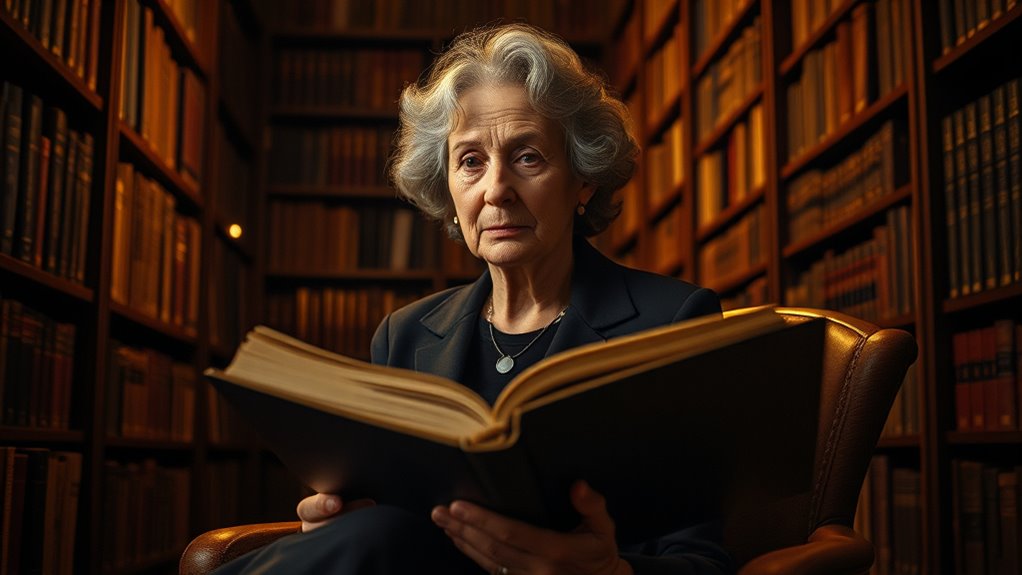
Margaret Atwood demonstrates that words are more than mere symbols—they are a source of power that can shape societies and challenge perceptions. Through her writing, you see how language becomes a tool to explore complex ideas about control, resistance, and human nature. Her works often explore dystopian themes, revealing worlds where oppressive systems manipulate truth and silence dissent. As you read her stories, you realize that words can be both weapons and shields, capable of dismantling or reinforcing societal structures. Atwood’s skill lies in weaving compelling narratives that expose the fragility of these systems, urging you to question what’s presented as reality. Her influence on literature is profound, inspiring countless writers and thinkers to examine the power of language in shaping human experience.
Words are powerful tools shaping societies, revealing truths, and challenging control through compelling narratives and dystopian visions.
In her dystopian novels, Atwood constructs unsettling worlds where language is a means of domination. In “The Handmaid’s Tale,” she depicts a society built on strict hierarchies and repression, where language is controlled to suppress individual identity. The phrase “Blessed be the fruit” becomes a tool of indoctrination, demonstrating how words can serve as both propaganda and a form of control. By crafting such chilling environments, Atwood shows you that narratives aren’t neutral—they’re instruments that can manipulate perceptions and enforce power. Her portrayal of dystopian themes highlights the danger of losing control over language, warning you of a future where words are weaponized against you.
Atwood’s literary influence extends beyond her dystopian themes. Her mastery of poetic prose and sharp social commentary shape how you think about the role of words in society. She encourages you to see language as a form of resistance, a way to challenge oppressive regimes and unearth uncomfortable truths. Her writings serve as a reminder that words carry weight; they can ignite revolutions or silence dissent. By examining her work, you understand that stories are not just entertainment—they’re acts of power that question the status quo. Her influence inspires you to reflect on how your own words can impact the world around you, whether through activism, storytelling, or everyday conversation. Additionally, her exploration of literary genres shows how diverse storytelling can amplify these themes and reach broader audiences.
Ultimately, Margaret Atwood demonstrates that words are more than mere symbols—they’re a potent force capable of shaping realities and shifting perceptions. Her exploration of dystopian themes reveals the destructive potential of language used unchecked, while her literary influence underscores the importance of speaking truth to power. As you engage with her work, you’re reminded that every word you choose can be an act of resistance or conformity. Atwood’s writing teaches you that language is a fundamental tool in the ongoing struggle for freedom, understanding, and justice. In her stories, you find a compelling call to harness the power of words—after all, a word after a word after a word truly is power.
As an affiliate, we earn on qualifying purchases.
Frequently Asked Questions
What Inspired Margaret Atwood’s Unique Writing Style?
You’re inspired by Margaret Atwood’s unique writing style because her literary influences, like dystopian fiction and feminist literature, shape her voice. Her narrative techniques, such as layered storytelling and vivid imagery, draw you in and make her work distinctive. You appreciate how she balances poetic language with sharp social commentary, creating powerful, thought-provoking stories that challenge conventions and keep you engaged from start to finish.
How Does Atwood Approach Future Dystopian Themes?
You see how Atwood approaches future dystopian themes by weaving technological warnings and societal critiques into her stories. She actively questions power structures and explores how technology can erode personal freedoms. Through vivid characters and sharp insights, she warns us about potential futures, encouraging reflection on current trends. Her storytelling prompts you to contemplate the risks of unchecked progress, making her work both compelling and thought-provoking, urging awareness and caution.
What Are Atwood’s Views on Contemporary Social Issues?
You see that Atwood actively engages with contemporary social issues, especially climate change activism and gender equality debates. She emphasizes the importance of awareness and critical thinking, often highlighting how societal power structures influence these topics. You’re encouraged to question norms and consider the implications of environmental and gender justice. Her work urges you to stay informed, advocate for change, and recognize the ongoing struggles for equality and sustainability in today’s world.
How Does Atwood’s Poetry Differ From Her Novels?
You’ll find that Atwood’s poetry uses vivid symbolism to pack a punch in a few lines, capturing emotions and ideas with lyrical precision. In contrast, her novels weave complex narratives, fleshing out characters and worlds over many pages. Poetry offers a snapshot of her thoughts, while novels let her explore themes more deeply. Think of poetry as a quick shot of insight and novels as a full-course meal.
What Influence Has Atwood Had on Modern Feminist Literature?
You see that Atwood’s work has markedly influenced modern feminist literature by challenging traditional gender dynamics and highlighting issues of power and inequality. Through her literary activism, she inspires you to question societal norms and advocate for gender equality. Her stories provoke critical conversations, encouraging writers and readers alike to explore feminist themes and push for social change, making her a pivotal figure in shaping contemporary feminist discourse.
As an affiliate, we earn on qualifying purchases.
Conclusion
Now, imagine each word you speak or write as a seed you plant in the garden of the world. With every word, you hold the power to shape, nurture, or even uproot the future. Remember, your words are the keys to unseal change—like a lighthouse guiding ships through darkness. So, choose them wisely. Because in the end, your words are the light that can illuminate the path for others, turning quiet whispers into mighty waves.
As an affiliate, we earn on qualifying purchases.
As an affiliate, we earn on qualifying purchases.
Fall Picks
fall essentials
As an affiliate, we earn on qualifying purchases.